 I am constantly amazed at how long America has simply plodded along accepting the manner in which the U.S. government constantly pushes for more GDP growth that never seems to quite ever benefit them nearly as much as it benefits those in power and at the top of Corporate America, in large part due to the Federal Reserve’s numerous financial schemes and scams derived from printing excessive amounts of money and facilitating high inflation and its manufactured boom and bust cycles.
Rather than get too far into all the statistics and fine minutiae of the American economy, this piece explains in simple terms what we see unfolding in today’s economic situation and the dynamics underlying it all. Despite the grand illusion that everything is rosy and just hunky-dory on our economic front, there are many matters that suggest the country is just one economic spark away from seeing it all burned down.
President Trump keeps pushing for greater growth of our GDP, which hasn’t exactly translated to greater wealth and benefits for America’s middle class and poor, for a litany of reasons discussed herein. Nothing can ever take the place of good old-fashioned Economics 101, in that you can’t keep spending enormous amounts more than you earn or bring into your accounts and expect anything other than eventually seeing your way to total economic ruin and the poorhouse.
Systemic risks in high-debt environments cannot be eliminated, only masked or shifted, and artifices only prolong bubbles and amplify eventual pops.
At some point the adults have to take charge of America’s economy and actually start paying down the national debt, or at the very least, halting all new unnecessary spending and living within whatever monies actually enter the U.S Treasury, no matter how few or many.
Folks like to believe the good times last forever. It’s a comforting notion, like thinking summer won’t end if you just don’t look at the calendar. But every farmer knows better. Every shopkeeper knows better. Every man or woman who’s ever run a household budget knows better. When you spend more than you earn for too long, the reckoning doesn’t vanish – it waits.
That’s the trouble with the American economy today. We’ve been living high on borrowed money so long that we’ve forgotten what solid ground feels like. And when the next recession comes – and it will – it won’t just be a cold winter. It’ll be the moment when the floorboards creak and we realize the house was hollowed out from underneath.
There’s a hard lesson every farmer learns sooner or later: you can cheat the land for a season, maybe two, but not forever. You can plant without rotating, pull crops without replenishing the soil, borrow against next year’s harvest to keep things going. For a while, it even looks like success. The fields stay green. The barns stay full.
Then one year the yield drops. The ground gives less than you took. And no amount of talk, promises, or prayers will make exhausted soil produce what it no longer can.
That’s where the American economy stands today.
For decades, we’ve been telling ourselves that growth is automatic, that recessions are optional, and that if trouble appears, someone in Washington or the Federal Reserve will fix it with cheap money and quick confidence. We’ve treated debt the way a reckless farmer treats land — as something endlessly forgiving.
Now, you’ll hear plenty of smooth talk saying otherwise. The experts will tell you recessions are relics, that the Federal Reserve has levers to pull and dials to turn, that a few interest rate cuts and a fresh pile of money will set everything right again. They’ve got an answer for every doubt and a chart for every worry.
But there’s an old saying worth remembering: you can’t print prosperity, and you can’t borrow your way to honesty.
A recession won’t cause the collapse that’s coming. It will simply reveal how hollow the system has already become.
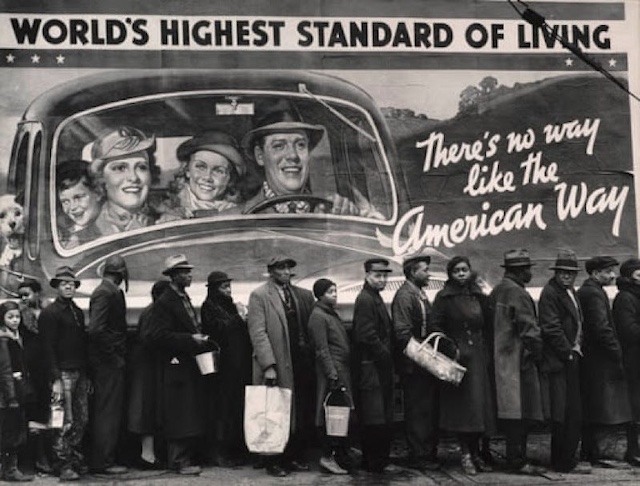
1937, World’s Highest Standard of Living [credit, Margaret Bourke-White]
Why Hard Times Exist
Once upon a time, Americans understood recessions the way sailors understand storms. Nobody wanted one, but everybody knew why they happened. When businesses made bad bets, when people borrowed too much, when money chased foolish schemes instead of honest work, the storm would come through and clear the air.
Once, Americans understood that hard times served a purpose. A bad year on the farm taught humility. A failed mine taught caution. A railroad that overbuilt and went bust taught investors to measure twice before laying track.
Recessions weren’t signs of failure — they were corrections. They cleared out bad debt, foolish speculation, and false confidence. They reminded people that profit must be earned, risk must be borne, and losses must be faced.
That wasn’t cruelty — it was discipline. It was the market’s way of saying, this won’t stand.
But somewhere along the line, we decided we were too advanced for that. We replaced discipline with intervention and accountability with assurance. Every dip in the economy became an emergency. Every loss demanded a rescue.
That wasn’t compassion. It was indulgence.
And indulgence, whether personal or economic, always carries a moral cost.
Somewhere along the line, we decided storms were optional. We sanded down the rough edges of capitalism and replaced them with government programs, central bank promises, and cheap credit. The idea was simple: keep growth going no matter what, and never let the party stop.
The trouble is, that markets — like people — don’t work that way.
How the Bubble Was Built
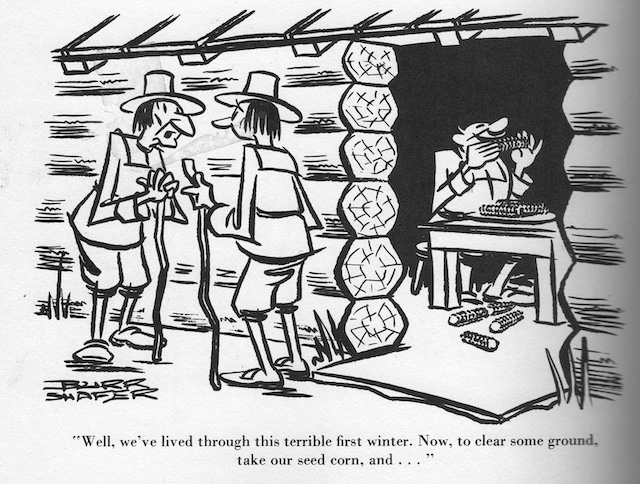
In farming communities, there’s an old warning: don’t eat the seed corn. That seed is supposed to go into the ground, not into your stomach. Eating it might get you through the winter, but it guarantees starvation later.
Our economy has been eating seed corn for a long time.
 Here’s how it usually goes. When times are good and money is cheap, people borrow. They don’t borrow to build barns or factories as much as they borrow to buy things that already exist — houses, stocks, land, financial paper with fancy names.
Instead of building growth on productivity — better tools, better skills, better output — we’ve leaned on debt. We’ve borrowed against the future to finance the present. We’ve treated rising asset prices as if they were the same thing as real wealth.
Cheap credit became the substitute for rising wages. Asset bubbles replaced savings. Speculation stood in for investment.
For a while, the harvest looked good. Houses rose in value. Stocks climbed. Retirement accounts swelled. But underneath, the soil — the income of ordinary households — was being depleted.
As prices rise, folks feel richer. That “wealth” becomes collateral. Banks lend more. Investors reach further. Riskier deals suddenly look reasonable, because yesterday’s gamble paid off.
It’s a merry-go-round of debt and hope. Everyone’s smiling, and nobody wants to be the one who says the music might stop.
But there are two things that never stop ticking: interest and risk.
Every dollar of debt carries an obligation. That’s not ideology. That’s arithmetic.
Interest must be paid. Risk must be compensated. And when borrowing expands faster than income, the math eventually breaks.
Central banks can delay that reckoning by holding interest rates low. They can talk soothingly to markets. They can promise to step in whenever trouble appears. But they cannot repeal the laws of finance any more than Congress can repeal gravity.
The Federal Reserve doesn’t eliminate risk — it disguises it. It signals safety where danger is growing. And that signal encourages people to dig deeper shafts, lay longer rails, and plant more acreage than the underlying ground can support.
In mining, that’s how collapses happen. You chase the vein too aggressively, ignore the warning signs, and one day the roof gives way. When it does, it doesn’t matter how confident you were the day before.
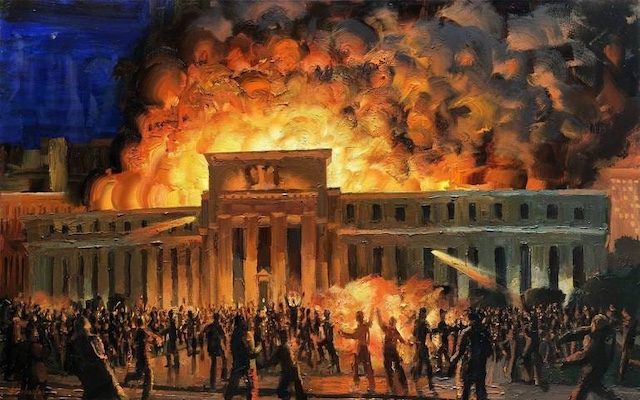
‘The Federal Reserve Bank in Flames’ by Alex Schaefer
Every dollar borrowed comes with a price. Every gamble carries the chance of loss. You can ignore that truth for a while — longer if a central bank keeps rates low and whispers sweet reassurances — but you can’t escape it.
The Great Illusion
For years now, the Federal Reserve has played the role of town savior. Whenever markets wobble, it steps in and says, Don’t worry. We’ve got your back. Investors hear that and breathe easy. They lend more. They speculate more. They pile risk on risk, confident someone else will eat the loss.
That confidence is built on a signal, not a guarantee.
Here’s where the moral imbalance becomes impossible to ignore.
Over the past half-century, productivity rose — but wages did not rise with it. The rewards flowed upward, toward corporations and asset owners, while workers were told to make do with debt.
Households didn’t borrow because they were reckless. They borrowed because paychecks lagged behind costs. Student loans replaced affordable education. Credit cards replaced savings. Auto loans stretched longer and longer.
Meanwhile, those who already owned assets benefited twice. Rising prices made them richer, and that wealth let them borrow more cheaply to buy even more assets. Their income rose without their labor increasing.
This isn’t just unfair — it’s unstable. A system that rewards ownership over production eventually runs out of producers.
You can’t build a railroad if everyone wants to own shares but no one wants to swing a hammer.
The Fed doesn’t own most of the debt in this country. It can’t force wages to rise. It can’t make bad investments good. All it can do is pretend risk is smaller than it really is — and hope the pretending lasts long enough.
That’s not capitalism. That’s wishful thinking dressed up in a suit.
The Paycheck Problem
Here’s the part that really matters, and it’s something anyone who works for a living understands instinctively.
For the past fifty years, productivity went up — but paychecks didn’t keep pace. The fruits of growth flowed upward, into corporations and assets, while wages lagged behind. So families did what families do when the bills rise faster than income: they borrowed.
Student loans ballooned. Credit cards piled up. Auto loans stretched longer and deeper. Folks weren’t getting richer — they were getting leveraged.
Meanwhile, the people who already owned assets saw their fortunes grow. Rising prices made them wealthier on paper, and that wealth let them borrow even more, at lower rates, to buy even more assets.
That’s how inequality grows — not just from greed, but from the math of debt and collateral.
When the Math Breaks
Every system has a breaking point. In this one, it comes when income can’t keep up with debt.
For years, the economy has been like a train running downhill on borrowed momentum. As long as the track was smooth and gravity cooperated, it looked unstoppable.
But the engine wasn’t being fed with coal — only credit.
Once households can’t service what they owe, the chain reaction begins. Missed payments turn into defaults. Spending dries up. Businesses lose customers and cut back. Workers get laid off. Investors sell assets to raise cash, and prices fall.
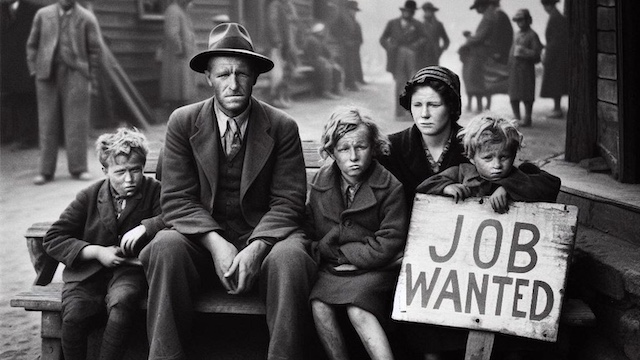 Once income growth slowed, once households hit their borrowing limits, the train began to lose power. Defaults followed. Spending fell. Businesses cut back. Layoffs spread. Investors sold assets to raise cash.
And just like a rail system, everything was connected. A failure in one section stressed the rest. Falling asset prices reduced collateral. Reduced collateral tightened credit. Tight credit caused more failures.
This isn’t chaos — it’s gravity.
And here’s the hard truth: today’s economy is more loaded with debt than at any time in American history. Back in the early 1980s, when the last real cleansing recession hit, total debt was manageable. There was room to recover.
Today, debt towers over the economy like a mountain of dry timber. One spark is all it takes.
No villain required. No conspiracy needed. Just the consequences of excess.
Why Old Fixes Won’t Work
Some folks say, The Fed will just cut rates again. Others say, The government will bail everyone out like it did in 2008.
 Some will say, we’ve seen this before. Cut rates. Print money. Bail out the lenders. Restart the engine.
But this time is different — not because human nature changed, but because the buffers are gone.
Those tools worked once because the system still had slack. Today, we’re tapped out. Rates are already low. Debt is already massive and towering over the economy. Interest rates are already low. Households are already stretched. More stimulus risks inflation without restoring trust. More borrowing won’t restart growth — it will strain the system further.
You can’t patch rotten railroad ties forever. Eventually, the bridge fails.
And when the signaling stops working — when people stop believing the Fed can rescue them — speculation dries up fast. Confidence evaporates. Asset prices fall faster and harder. The illusion of wealth vanishes.
The Fed Is ABOUT TO PRINT!! Watch This NOW!!
The Reckoning We’ve Been Avoiding
In a healthy economy that allows mistakes to be corrected, bubbles popping are painful but survivable, and lessons emerge that should be learnable, but too often of late, they’ve been ignored. In an economy dependent on bubbles to function, bursting becomes existential and the dynamic that currently threatens the whole structure.
That’s the danger we face now.
The arrival of next recession will be treated as an unexpected disaster, but it will be nothing of the sort. It will be the moral consequence of decades spent avoiding responsibility, rewarding leverage over labor, and mistaking paper gains for real prosperity.
When the next recession hits, it won’t be an unexpected tragedy. It’ll be the overdue bill for decades of pretending debt could replace productivity, and confidence could replace income — and in all actuality and reality, it will more than likely not be a recession but rather a full-blown devastating New Great Depression.
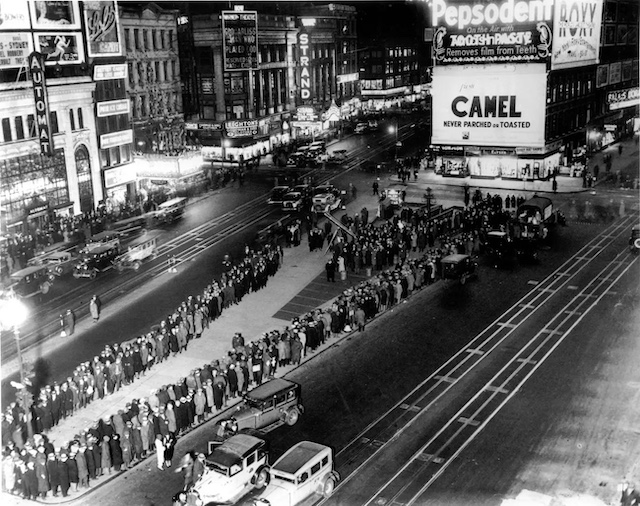
Thousands waited in long lines to receive food during the Great Depression
No amount of fancy money — digital, metallic, or otherwise — changes that reality or alter the truth. Debt doesn’t disappear just because the measuring stick changes. Debt still demands payment. Risk still demands respect.
You can’t rename a bad harvest into a good one.
What Comes After
The way forward won’t be easy or quick. It will demand real investment in productive work, not paper wealth. It will require gains to be shared more broadly so households can save instead of borrow. It will require accepting that markets need discipline the same way people do.
The way forward isn’t glamorous. It won’t enrich paper fortunes overnight. It won’t spare every loss.
It means rebuilding growth on productivity, not leverage. On work, not wagers. On investment in real things — skills, tools, infrastructure — rather than financial smoke.
It means letting losses occur so capital can be reallocated. Letting recessions clear excess so recovery can be genuine. Letting rewards follow contribution, not proximity to cheap credit.
That takes time. It takes sacrifice. And it takes moral courage.
And it will require something Americans once had in abundance: patience.
The winners of the old system will protest. They’ll want the good times back, just the way they were. But that road’s washed out. Those who prospered most under the old system will demand its return. They’ll call discipline cruelty and restraint recklessness. But the ground they were farming is spent, and the mine they were digging is unstable.
The choice isn’t between pain and comfort.
It’s between honest correction now and catastrophic collapse later.
You can’t live forever on borrowed time. Eventually, the clock runs down. And when it does, the only solid ground left is work, productivity, and honest accounting.
You can’t fool the soil forever. You can’t ignore the mountain’s weight. You can’t run a railroad on borrowed steam.
The next Great Depression won’t destroy the system, and it won’t be the end of America’s story.
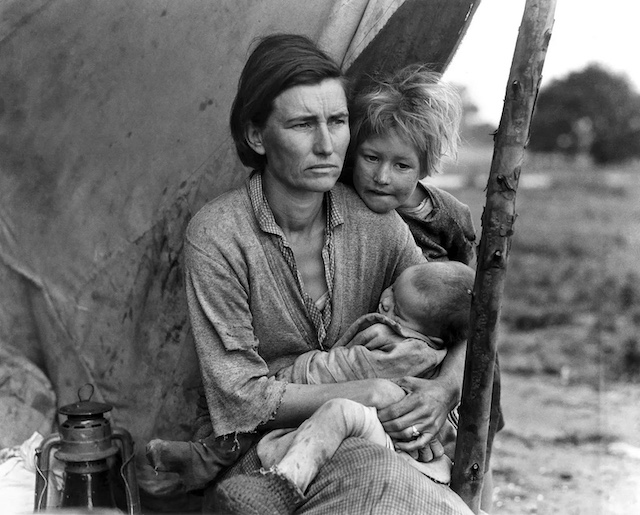
“Migrant agricultural workers,” Dorothea Lange, Nipomo, California, March 1936 – Library of Congress
It will simply show us what the system really was. It will be the moment the story finally starts telling the truth.
February 3, 2026
Justin O. Smith ~ Author
~ the Author ~
Justin O. Smith Has Lived in Tennessee Off and on Most of His Adult Life, and Graduated From Middle Tennessee State University in 1980, With a B.S. And a Double Major in International Relations and Cultural Geography – Minors in Military Science and English, for What Its Worth. His Real Education Started From That Point on. Smith Is a Frequent Contributor to the Family of Kettle Moraine Publications.