Who is Franklin Sanders, a.k.a. “The Moneychanger“?
 [Over 50] years ago, just a few weeks before I got married, on a drugstore bookstand I found a strange book: Capitalism, the Unknown Ideal. It was a collection of essays about a philosophy of freedom. Two dealt with the American monetary system. The author explained that nothing — no gold or silver — backed our currency. He argued that sooner or later, this fiat money system would lead to disaster, and that only a money backed by real value — gold — could last.
That author was Alan Greenspan. Since then our careers — Alan’s and mine — have taken very different paths. Continue reading
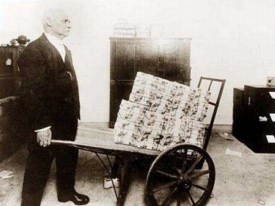 It was horrible. Horrible! Like lightning it struck. No one was prepared. The shelves in the grocery stores were empty. You could buy nothing with your paper money. ~ Harvard University law professor Friedrich Kessler on on the Weimar Republic hyperinflation (1993 interview)
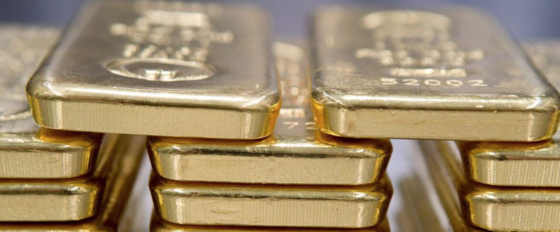 “Buying the dips” will define gold’s latest trading pattern as the precious metal heads towards $1,300 in the near-term, guided by a dovish Federal Reserve and an aversion to risk amid U.S.-China trade tensions, according to TD Securities.
 Historically, gold has never been viewed as a speculation. It was simply money: cash in the most basic form. It was a medium of exchange and a store of value. People did not accumulate gold because it could make them wealthy, but because it was a convenient, liquid way to keep the wealth they had.
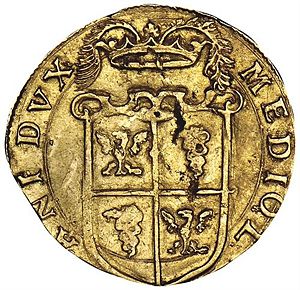
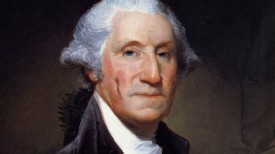 President George Washington received a bill that would create a national bank if he didn’t veto within 10 days. National-government power to print money not backed 100% by reserves of gold or silver had been voted down by Washington’s Constitutional Convention by a supermajority of 9 to 2. Four short years later, Treasury secretary Alexander Hamilton claimed the opposite: that the Constitution implies that the national government can create a national bank that prints fractional-reserve money. Washington ran with this, didn’t veto, and instead
 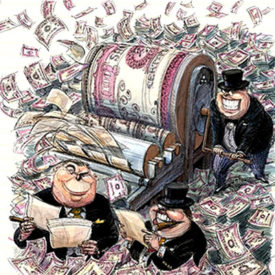 If the United States’ central bank, the Federal Reserve, stops printing money, the stock market will crash. However, the continual printing of money could cause a crash of its own. Either way, we are in a lose-lose situation when it comes to the decisions made by central bankers.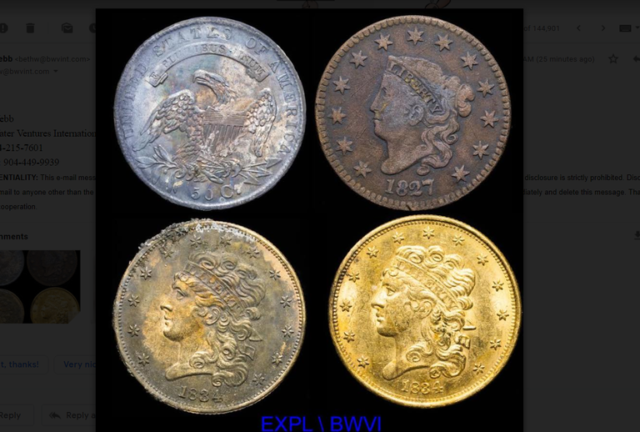
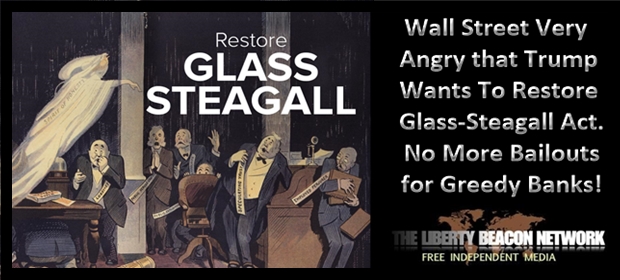 The central struggle since the inception of the Republic has been about the control of money. Since the U.S. Constitution clearly defines coinage, the objective of the mercantile elite was to circumvent the law and establish a National Bank. Woe to any defender of President Andrew Jackson for abolishing the