Silver Outshines Gold: Prices Surge 6% to $77
 The ceasefire agreement between the U.S. and Iran propelled gold and silver prices to nearly two-week highs. Silver outperformed gold, with spot prices surging over 6% to $77.64 per ounce, while gold rose over 2% to $4,836 per ounce. This divergence is attributed to capital rotation from gold toward industrial metals like silver, driven by easing supply chain and energy concerns and expectations of economic recovery. However, silver’s higher volatility means it could retrace faster than gold if negotiations fail.
Spot gold prices rose by more than 2%, breaking through the $4,800 per ounce barrier to reach a high of $4,836, touching its March 19 peak. Clearly, both gold and silver rebounded past key levels, but gold’s gains lagged behind those of silver. Why is this the case?
The easing of U.S.-Iran tensions and the reopening of the Strait of Hormuz have significantly alleviated global supply chain and energy concerns. This has prompted capital to rotate from gold as a pure safe-haven asset toward industrial metals linked to economic recovery expectations, allowing silver to benefit more.
However, if the Islamabad negotiations prove fruitless, silver, as a high-volatility asset, could also see a faster retracement than gold… (Continue to full article)
The Oil Prices Plunge to Under $100 a Barrel With TrucePrice of Coffee Is Skyrocketing Faster Than All Other Groceries — and the Reason Goes Way Beyond Tariffs
 Oil prices plunged and U.S. stock futures jumped after President Donald Trump held off on his threat of devastating attacks on Iran. U.S. crude oil futures fell more than 15%.
Late Tuesday, Trump said he was holding off on his threatened attacks on Iranian bridges, power plants and other civilian targets, subject to Tehran agreeing to a two-week ceasefire and reopening of the Strait of Hormuz. Iran’s Supreme National Security Council said it has accepted a two-week ceasefire and its foreign minister said passage through the strait would be allowed for the next two weeks under Iranian military management.
Futures for U.S. crude oil sank 14.7% to $96.27 a barrel, while Brent crude oil, the international standard, dropped 14.4% to $93.48. The price remains well above where it was at the start of the war… (Continue to full article)
Coffee Prices Tumble on Abundant Global Supplies Paid $3.89 for Gas on Monday. By Wednesday It Was $4.29

HOT morning coffee!!!
Coffee prices are plunging today, with arabica falling to a 3-week low and robusta dropping to an 8-month nearest-futures low. Coffee prices have retreated over the past two weeks amid expectations of a record Brazilian coffee crop. On March 19, Marex Group Plc projected a record 2026/27 Brazil coffee crop of 75.9 million bags, even higher than Sucafina’s forecast of 75.4 million bags, up +15.5% y/y.
On March 12, StoneX raised its Brazil 2026/27 coffee production estimate to a record 75.3 million bags, up from a November estimate of 70.7 million bags. Meanwhile, StoneX projected the 2026 global coffee surplus will expand to 10 million bags from 1.8 million bags in 2025, the biggest surplus in 6 years… (Continue to full article)
Here’s What $25,000 in Gold Could Look Like by the End of 2026
 It’s no secret that the price of gold has been volatile over the last year or so. Gold’s price trajectory went from reaching new record highs month after month to declining and then surging back, with even more ups and downs in between.
The gold price rollercoaster is being driven by a few factors, including inflation trends, Federal Reserve policy, ongoing geopolitical uncertainty and the changing investor demands that have resulted. Even after all that movement, though, gold still sits at $4,690 per ounce (as of April 6, 2026), which is well above its price from even one year ago.
Does that mean it’s a good idea to invest in the precious metal right now? Here’s what experts say you could expect to happen by the end of the year if you invested $25,000 in gold today… (Continue to full article)
Millions of Americans Paid Billions in Tariffs Later Ruled Illegal — and They Won’t See a Dime Back
 Low – and Middle-Income American families, and small businesses, accounting for well over half of our country’s population, paid out a disproportionate share of their incomes to the government due to IEEPA Tariffs recently struck down by the Supreme Court. Total payments amounted to roughly $175 billion. Now these families and small businesses face the prospect of receiving no rebates. Thus, the system is regressive for them on both the front and back ends — the burden of the original high tariffs and now the denial of rebates to compensate them.
As the result of the so-called “Liberation Day” tariffs announced April 2, 2025, retail prices rose by between 6 and 7 percentage points, costing the average American household between $400 and $600 — and many considerably more. For low-income families especially, this was a painful gouge into their incomes.
300 million-plus Americans assumed most of the burden virtually every time they went to the grocery store, bought a car, or purchased a pair of shoes, a dress, or a home appliance. Small businesses lost as well because most of the costs of the tariffs paid by larger importers or wholesalers were passed on to them. Most consumers and small businesses have NO clear recourse to getting any of their money back.
As a result – WE the Peeps get Screwed!!! (Continue to full article)
 Most of the pre-packaged garbage that we are being sold in our local grocery stores is “Frankenstein food”, but even though this is widely known most of the general population just keeps gobbling it down anyway. This is something that I have been wanting to write about for quite some time.
 The investment bank’s global wealth management office doubled down on its bullish stance on gold in a note published on Monday. Analyst Wayne Gordon and his team said that despite the recent declines, they think investors should stick with gold as a defensive hedge.
 America owed about $75 million in debt from the Revolutionary War. Individual states had already defaulted. Foreign creditors considered the new country a total joke. And domestic bondholders at home were selling their worthless government IOUs for pennies on the dollar.
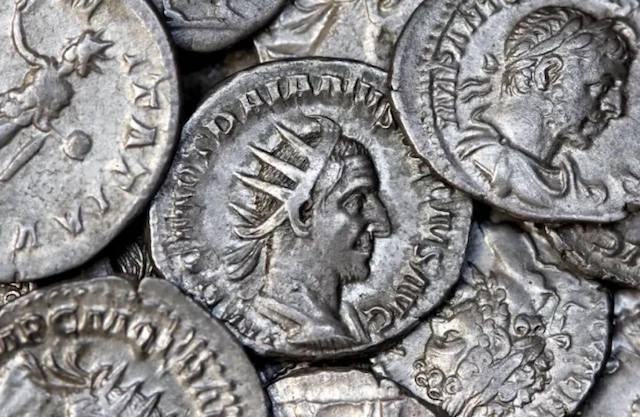 In frenetic modern life, with its emphasis on the now and the brand new, most people are more concerned with owning the latest iPhone than owning some relic of the past. But that’s a mistake.
 The U.S. government has been declared insolvent by the Treasury Department, according to its consolidated financial statements for fiscal year 2025. The report shows total assets of $6.06 trillion against liabilities of $47.78 trillion as of September 30, 2025, a stark financial picture that has largely gone unnoticed in the media.
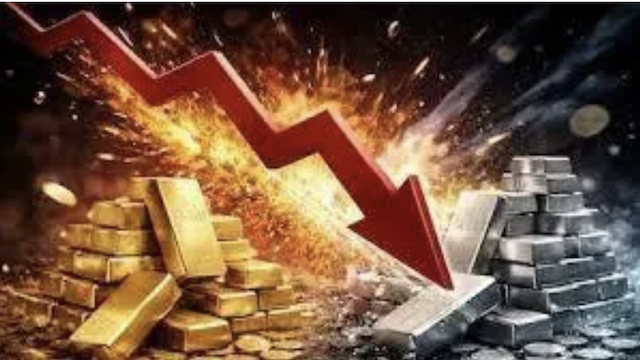 If you are new to gold, or if you are a speculator in gold (or even worse, a levered speculator in gold), you are likely asking yourselves what in the “H. E. double tooth-picks” just happened to gold?
 A worst-case scenario could be just weeks away. Traffic through the Strait of Hormuz has been essentially paralyzed by the war with Iran, and there is a lot of speculation that the Houthis could soon bring commercial traffic through the Red Sea to a screeching halt. If such a scenario actually materializes, it would be catastrophic for the global economy.
 A few years ago, the idea of gold prices going to $10,000 was seen as ridiculous, but now it is looking like a real possibility as global debt continues to create deepening structural shifts in the geopolitical landscape, according to one market strategist.
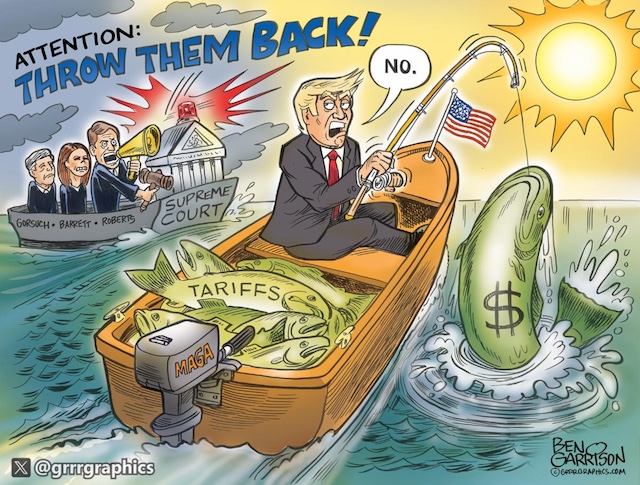 By majority decision, the Supreme Court has ruled the tariffs put in place by President Trump to be unlawful. Three so-called ‘conservatives’ on the court sided with the lefty judges. Chief Justice John Roberts along with Justices Amy Coney Barrett and Neil Gorsuch should have sided with Trump and his efforts to make America great again. Instead, they want America to fail, resulting in America becoming a globalist, socialist cesspool.