By law, the U.S. Mint must buy American gold. Instead, they are buying drug cartel gold while assuring us it is American gold
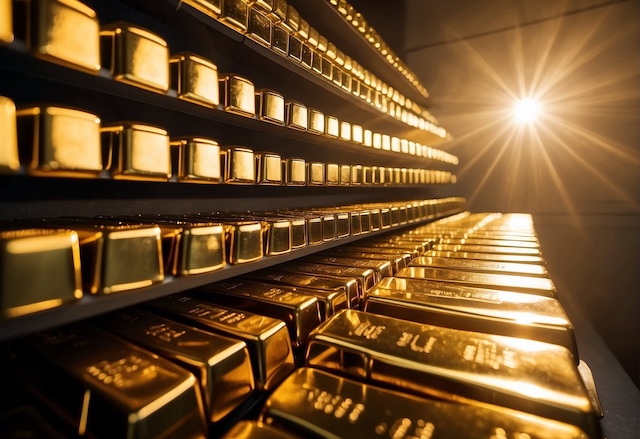 “To hold a coin or medal produced by the Mint is to connect to the founding principles of our nation,” the U.S. Mint declares. That is a lie. In 1985 Congress passed a law prohibiting the Mint from making coins and bullion bars from foreign gold because it wanted to divorce that process from human rights abuses like South African apartheid practices.
An investigation team of reporters from the New York Times, Justin Scheck, Simón Posada, and Federico Rios, have exposed the Mint scam in an article published on 27 April. Much of my data here is taken from that article.
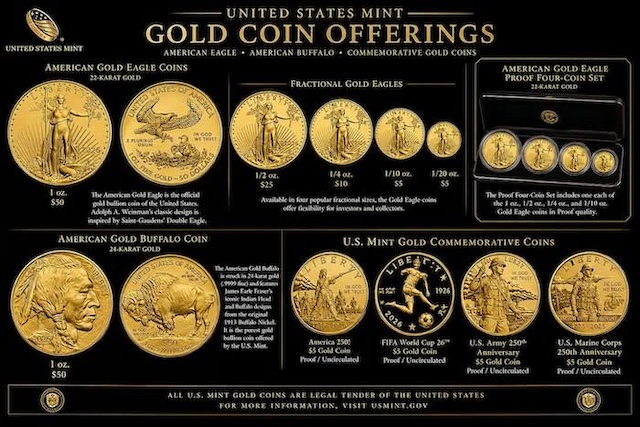
The Mint currently mints several gold coin programs in two categories, investment coins and collector numismatic coins. Below are investment and commemorative coins.
Because of the current gold frenzy, the Mint sells more than a billion dollars of these coins every year, including small bars of gold. But the Mint buys gold to make those coins from a Colombian drug cartel mine. It also makes coins from gold that originated in Mexican and Peruvian pawn shops and even from a Congolese mine that is partly owned by the Chinese government. Some Mint gold comes from a company in Honduras that dug up a native graveyard for the gold beneath.
When the investigating reporters approached the Mint with these facts the Mint said America was its “primary” source and assured them that the Mint was taking steps to better track its gold sources.
The person who oversees the Mint is Treasury Secretary Scott Bessent, and he said that he would investigate gold procurement practices. In a subsequent written statement he said, “This review is focused on ensuring that the U.S. Mint’s gold suppliers comply with the law and strictly satisfy their obligations, and that the Mint takes every step possible to continue to vigorously safeguard our national security and uphold market integrity.” The enforcement steps that the Treasury Department should make to backup that statement are still known.
For illegally mined foreign gold to become a Mint coin, two acts of magic must happen: First, illegal gold must become legal gold, and second, it must become American.
To begin to see how that magic was done the reporters went into the heart of the drug dealing Clan del Golfo territory in northwestern Columbia. They visited a ranch the miners called La Mandinga, the name of an evil spirit. Clan del Golfo is Columbia’s biggest cartel, and it traffics in cocaine and gold. To mine gold the hundreds of mining teams must get permission from the cartel that subsequently “taxes” them.
The magic of making Mandinga gold legal is buried in paperwork
The magic of making Mandinga gold legal is buried in paperwork. Before a mining group goes to work it must be licensed by the Columbian government. The miners must state that they will mine in authorized areas and use only hand tools. The shop to which they sell their gold in Caucasia, a gold rush town nearby, knows they are mining in an unauthorized area, that they are not using hand tools, and that they are using mercury to consolidate their gold. The Columbian government rarely checks the mining group to determine their gold’s legality.
The shop owner simply asks if the gold has the paperwork. The miner has a government license, so the paperwork is in order. The shop then sells the gold to a government-owned exporter who checks the same database that the shop uses to verify the gold’s origin.
It is then that the gold has become legal.
The Columbian government shipper then sends the gold to a Dallas Texas refinery named Dillon Gage. There Mandinga gold is mixed with gold from other suppliers like U.S. jewelry dealers, Peruvian pawn shops and other South American mines, according to company records.
Dillon Gage mixes American gold with Colombian and Nicaraguan gold. As gold industry logic goes, the end product is thereafter American. “As far as they’re concerned, it originated within the U.S.,” said Terry Hanlon, Dillon Gage’s chief executive.
Once in Texas the gold suddenly becomes American.
Hanlon said his company was always on the lookout for illegal gold. But at this point, the Mandinga gold was legal because of Caucasia shop ledgers and export records. Hanlon said to the Time’s reporters that he was surprised they found cartel gold in his pipeline. Dillon Gage has suspended purchases from the Colombian-owned exporter.
A Utah refiner called Asahi USA is one of the largest Mint suppliers and does not deny that its cauldrons contain gold from different countries. “It’s commingled,” said Paul Healey, the company’s refining chief. Healey also said the company will investigate the Time’s reporters’ findings about the Clan del Golfo.
U.S. Gold Reserves Unfit for International Transactions
The Mint’s gold sourcing practice raised concerns when the inspector general of the Treasury Department asked questions during President Trump’s first term. That investigation took five years to complete, and the auditors found serious problems. They said that the Mint was not following its own policies.
In 2024 the Biden administration said it was just months away from publishing new plans for investigating gold sources. It never did.
A Treasury spokeswoman said that the current Trump administration was taking steps to identify its gold sources. But it has not cut off foreign gold. Doing so, she said, would make it impossible to meet the current demand.
The better part of U.S. gold reserves in Fort Knox and other depositories is made up of “non-standard” bars that do not qualify for use in international settlements. That means most of America’s gold reserves is illiquid and would not be accepted on the international market should the need arise. “It’s a decrepit relic just like our monetary policy is. With respect to America’s gold stockpile, we hold ourselves to a lower standard than the rest of the world,” said Stefan Gleason, CEO of Money Metals.
Reports say U.S. gold reserves amount to 8,133.5 tons, despite the lack of reliable physical audits for many years. According to the London Bullion Market Association, to be acceptable for international settlements gold bars must contain 350 to 430 fine troy ounces and have a minimum fineness of 995.0 parts per thousand. Global ‘good delivery’ standards are already transitioning to 0.9999 purity.
A 2011 House Committee on Financial Services hearing discovered only 17% of gold bars in Fort Knox meet today’s purity standards. An “audit the gold” bill introduced last year by Senator Mike Lee (R-Utah) would require a reliable audit of U.S. gold reserves, including an accounting of any gold transactions. It will also require the Mint to refine below standard bars so that they meet modern requirements for international settlements, a process that will take several years.
Senator Lee’s bill has not been passed by our dysfunctional Congress.
Why So Many Sub-Standard Gold Bars?
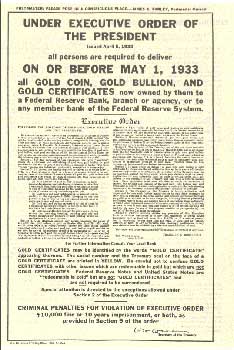 President Franklin Roosevelt needed to expand the money supply to support his spending plans. On 5 April 1933 he signed Executive Order 6102 that made private ownership of gold illegal to prevent “hoarding.” Private banks, the Federal Reserve and citizens held coins that were generally 90% pure. All were paid about $20 for their coins and gold bars.
Six months later, Roosevelt devalued the dollar by about 40% when he declared that gold was worth $35.
William C. Wood, in an article published in 1994 by The Journal of Economic Education, said the Fort Knox depository was “an artifact of the gold standard days.” He also noted that, “The gold resulting from melting of coinage has considerably lower quality than the ‘fine’ or ‘good delivery’ gold commonly used in international trade. The majority of the gold in Fort Knox is the lower-quality coin gold.”
Gold Revaluation
The U.S. government now holds 261.5 million ounces of gold and values it at $42.22 per ounce based on a 1973 law. That price does not fluctuate with gold market movements.
With gold trading today above $4,700, this represents more than $1,229 trillion in unrealized value. Senator Cynthia Lummis (R-WY) has proposed a bill (S.4912) that will revalue the U.S. gold reserve to market prices, potentially generating that $1,229 trillion without raising taxes or cutting spending.
In 2026, global central banks have so far purchased 244 tons of gold. Poland leads with 31 tons and Uzbekistan follows with 25 tons. 73% of those global central banks plan to reduce their dollar holdings.
Other countries have tried the Cynthia Lummis plan.
In 2002 Italy’s Banca d’Italia transferred 13 billion euros from gold revaluation accounts. Those reserves existed because gold held on the balance sheet had risen in market value above the old book values. The move mainly helped the central bank to avoid reporting a net loss and show a modest profit instead as well as stabilizing its balance sheet accounting position. Italy continues to have high public debt, low economic growth and structural rigidities in labor and product markets. Italy’s case shows that revaluing gold reserves can buy time, improve optics, or patch a balance sheet, but it does not replace sustained growth and fiscal reform.
Dysfunctional Congress and a domestic judiciary currently at war with the Trump administration

“Gold, Mr. Bond.”
In 2002 Lebanon used revaluation gains to reduce debt and fund government needs. The amount was significant. It was estimated at 11% of GDP, much larger relative to the economy than similar moves in other countries. Deeper problems persisted like very high government debt, chronic budget deficits, weak growth, and currency pressures. These issues compounded over time, culminating in Lebanon’s severe financial crisis beginning in 2019, including sovereign default in 2020, a banking sector collapse, sharp currency depreciation, inflation and loss of savings, and a deep economic contraction. Lebanon is a clear example that a gold reserve revaluation can create a temporary financial patch, but if debt, governance, banking, and currency problems remain unresolved, the benefit will be ultimately overwhelmed. And the current war with Israel has made Lebanon an economic basket case.
In 2021-2022 Curacao & St Maarten’s central bank sold and repurchased gold to get the gains. The move helped to offset central bank operating losses, strengthened the central bank’s financial position, improved reported capital and earnings, and supported monetary credibility during a difficult post-pandemic period. However, the islands still face normal small-economy challenges like dependence on tourism, exposure to global downturns, hurricane and weather risks, and limited economic diversification.
In 2024 South Africa used gold reserve revaluation gains for government debt reduction. The estimated effect was around 2.07% of GDP, meaningful but not game changing. The revaluation did provide a stronger short-term fiscal position and was much better than the Lebanon outcome. There was no immediate crisis spiral from the revaluation itself. But growth and governance reforms still remain more important than revaluation gains.
The common pattern of revaluating gold reserves can create a one-time financial boost, but it does not magically solve ongoing economic problems like the national debt level, slow growth, and political unrest.
That includes a dysfunctional Congress and a domestic judiciary currently at war with the Trump administration.
Written by Chet Nagle for the Canada Free Press ~ May 12, 2026