Hospitals Are Quietly Dropping Medicare Advantage Plans, and a New Survey of Hospital Finance Leaders Finds Nearly a Quarter Have Already Cut or Narrowed a Contract

The reality is – that they DON’T Care!
A growing number of hospitals are cutting ties with Medicare Advantage plans, and the finance executives who run those systems say the retreat is only picking up speed. A flash poll of hospital and health-system finance leaders released in mid-August found that nearly a quarter have already terminated, declined to renew, or materially narrowed at least one Medicare Advantage contract. For the more than 30 million older Americans enrolled in these private plans — over half of everyone on Medicare — the shift carries a concrete risk: a hospital or physician who is in network today may not be next year.
The research was a third-quarter flash poll of 112 hospital and health-system finance leaders conducted by Black Book Research. Among the 104 respondents whose organizations carry material Medicare Advantage exposure, 23.1 percent said they had already terminated, declined to renew, or materially narrowed a Medicare Advantage contract. Another 18.3 percent expected to take that step within the next 12 months, and 33.7 percent said they were actively evaluating a pullback.
Taken together, roughly three in four finance leaders reported that their systems have acted, expect to act, or are weighing a retreat from at least one plan, according to the survey reported in an August 14 release. The picture that emerges is not of a few outliers but of a broad industry recalculation, with the split between systems that have already moved and those still deliberating running close to even… (Continue to full article)
When a Carpenter in California Found a Nugget of Gold, It Started a Rush Toward Nothing Less Than the Modern World

The Smithsonian holds a nugget, above, thought to have been discovered by James Marshall in 1848. National Museum of American History
On January 24, 1848, a carpenter named James Marshall found a nugget of gold while building a mill in the foothills of the Sierra Nevada. This moment started the gold rush that would bring thousands to the territory known as California. In The Rush: California Gold, the Civil War and the Making of the Modern World, the latest book by prolific historian Nathaniel Philbrick, Marshall’s discovery is a decisive historical moment, sending a fledgling nation “hurtling toward a reckoning not only with slavery but with its geographic immensity.”
In 1849, around 100,000 people reached California looking to capitalize on the rush. That included around 40,000 people arriving by sea, plus 25,000 to 30,000 others traveling by land across the Plains.
Foreigners seeking a piece of the rush included immigrants from China, Mexico, Chile, Hawaii and Europe. In 1852 alone, some 20,000 Chinese immigrants arrived in California, accounting for nearly 30 percent of that year’s immigration to the state.
San Francisco’s growth is illustrative. In 1848, the city’s population was around 850. That number rose to 5,000 by July 1849, and to a whopping 25,000 by December 1849 … (Continue to full article)
Twenty-Five Health Systems Dropped Medicare Advantage This Year, Some Quitting on 30 Days’ Notice
 The retreat from Medicare Advantage is no longer coming only from insurers. This year, hospitals and doctor groups have started walking away too. At least 25 health systems across the country have dropped or declined to renew Medicare Advantage contracts in 2026, and in some cases the exit took effect on roughly 30 days’ notice, cutting patients off from in-network access in the middle of a plan year. It is a quieter story than an insurer pulling a plan, but for a patient mid-treatment it can be just as disruptive.
Medicare Advantage plans are run by private insurers that contract with hospitals and physicians to build their networks. For years the friction ran one direction, with insurers dictating terms. Now a growing number of provider systems are deciding the arrangement no longer pays. The two complaints surface again and again: reimbursement rates that trail the actual cost of care, and prior-authorization processes that slow down or deny treatments doctors say patients need.
Prior authorization is the requirement that an insurer approve a service before it is delivered. Health systems report spending heavily on staff to chase those approvals, appealing denials for care that Original Medicare would simply cover. When the administrative cost and the payment shortfall stack up, some systems conclude that staying in a plan’s network is a money-loser and give notice… (Continue to full article)
Mark Cuban’s Pharmacy Steps in After Insurer Denied a 26-Year-Old Heart Transplant Survivor Her Anti-Rejection Drug
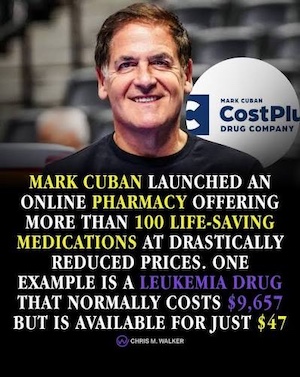 In 2025, Americans spent $5.6 trillion on health care, and that number is projected to climb to as much as $8.6 trillion by 2033. For some patients, the biggest financial burden comes after their insurance claim is denied.
That’s what happened to 26-year-old Payton Herres. The heart transplant survivor was left without coverage for a critical drug — and it took viral social media posts and attention from billionaire Mark Cuban for her to finally get more affordable access to it.
Herres underwent a heart transplant when she was just a preteen. One year after her surgery, she began taking a prescription drug called everolimus, a generic version of Novartis’s anti-rejection drug Zortress, off-label.
Her insurance provider, Elevance Health, told her last year that it would no longer cover the drug. That’s when she took to Facebook to share her story… (Continue to full article)
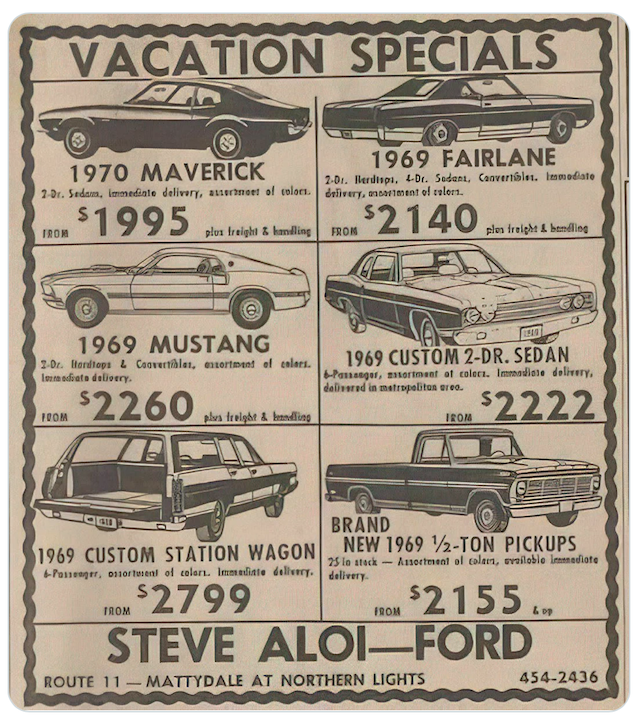
The Price of Ford Cars in 1969. Which Would You Choose?
Copper’s Record Run May Just Be Getting Started
 Copper has spent 2026 rewriting its own history books. In early August, the metal pushed above $14,300 per tonne on the London Metal Exchange, a fresh all-time high extending a rally few expected to run this far, this fast.
For Jacob White, Director of ETF Product Management at Sprott Asset Management, the surprise isn’t that copper is at record levels, but how long the setup has been building.
“We’ve been on the copper bull market story for quite a while now,” White said in an interview with Proactive.
White points to a fundamental supply deficit that Sprott expects to widen rather than close. New mine supply is notoriously slow to arrive. White cited an average timeline of 17.5 years from discovery to first production, a lag that leaves the industry structurally unable to respond quickly to demand growth… (Continue to full article)
Rand Paul Inspects Fort Knox Gold, Says Dollar’s 97% Collapse Since 1913 Is Behind America’s ‘Affordability’ Crisis: ‘The Real Point Is…‘
 Sen. Rand Paul (R-Ky.) toured Fort Knox to inspect the gold reserves on Monday, voicing concerns over the diminishing purchasing power of the dollar.
Paul, in a post on Monday, stated that Fort Knox holds approximately 147 million ounces of gold, which is half of the U.S. gold reserve, but argued its deeper lesson is monetary. Since the dollar left gold in 1971, he says it has lost roughly 85% of its value.
In another post, he pointed out that the dollar has lost 97% of its purchasing power since the Federal Reserve was established in 1913. He equated $100 in 1913 to $3,300 today, blaming this on Congress’s unchecked spending and the Federal Reserve’s money printing.
Paul linked today’s affordability crisis to inflation, citing $2 trillion annual deficits… (Continue to full article)