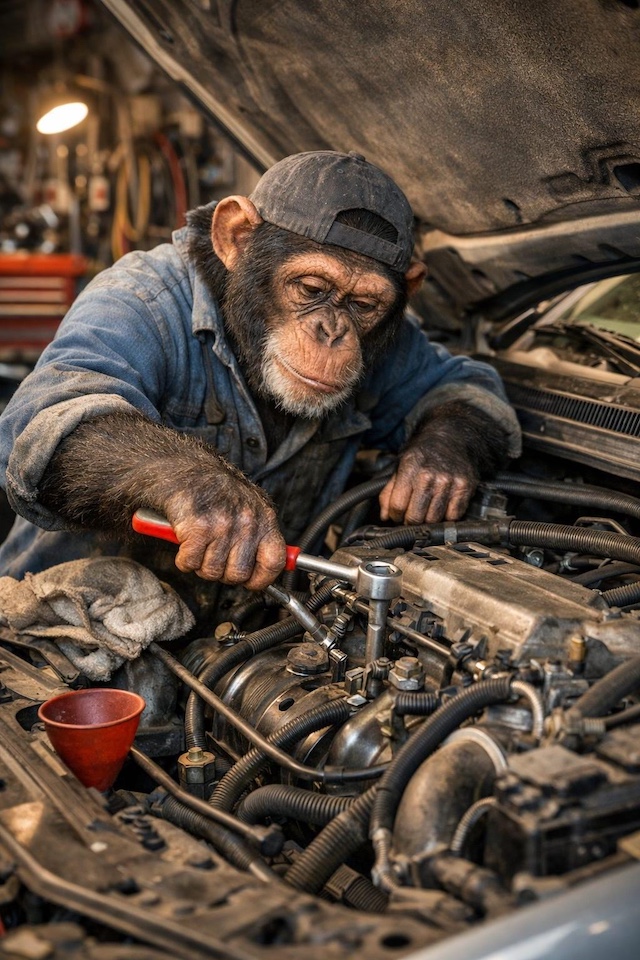
Me, working on my car in the garage last night to escape the high price of hiring a real mechanic
Well now, let’s sit a spell and talk straight about this here American economy, the way a man might lean on a fence rail and tell it to his neighbor without any fancy talk or Washington double-speak.
Right now, in the fall of 2026, the numbers on the surface look pretty fair. The country’s still growing — factories humming, shops taking orders, folks going to work. About a hundred and sixty thousand new jobs showed up in August alone, and the unemployment line sits at a tolerable four percent and change. Poverty’s down to about one in ten people, the lowest we’ve seen in a long while, and the average family is bringing home more real money than ever before — somewhere around eighty-seven thousand dollars a year after you adjust for the rising cost of everything. Wall Street’s stock numbers keep climbing like a young man full of beans, and the big companies are making profits that would make an old-time banker whistle.
That’s the good side of the ledger, and it ain’t make-believe. You can thank a few sensible moves for some of it — cutting red tape so a man can open a business without drowning in paper, pumping more of our own oil and gas so we ain’t quite so dependent on the world’s troublemakers, and telling foreign outfits that if they want to sell here they’d better play by rules that don’t leave American workers holding the short end. Those things help. They always have.
But here’s the part the politicians on both sides prefer you didn’t notice too hard. A dollar today buys what eight or nine cents bought back when Eisenhower was in the White House. The same basket of groceries, the same tank of gas, the same roof over your head — it all costs a heap more than it did just a few years ago. Prices jumped something fierce under the last crowd, about twenty-one percent overall and closer to thirty percent on the things that hit closest to home — houses, cars, insurance, doctor bills, and the food on the table. The new bunch has slowed that climb down to a little over three percent a year, which is better, no doubt. But slowing the bleed doesn’t put the blood back in the patient. The high prices are still sitting there like a heavy rock on every family’s chest.
A DOLLAR In 2026 BUYS WHAT 8.5 CENTS DID IN 1957, Regarding Everyday Prices.
A DOLLAR In 2026 BUYS WHAT 33.2 CENTS DID IN 2000, Regarding Housing.
And today it takes $16.86 to buy the amount of gold that $1 bought in 2000.
And it’s only getting worse.
That’s why so many ordinary folks feel the squeeze even while the big numbers over on Wall Street look so rosy. Gas has been jumping around because of trouble overseas, and when a working man has to shell out four-fifty or five dollars a gallon just to get to the job, it cuts deep. Wages have been rising a bit faster than prices lately, which is a mercy, but for a lot of people it still feels like running uphill in soft sand. Consumer confidence — that gut feeling people have about whether tomorrow will be better — is down in the dumps, lower than it’s been in years. Folks know the difference between a headline that says “economy growing” and the reality of stretching a paycheck to cover rent, groceries, and a tank of gas.
“Fewer Americans are identifying as middle class today than prior to the 2008 recession. Nearly half of Americans are dipping into savings just to cover routine expenses. With higher prices at the pump, rising food costs, and elevated everyday expenses, middle-income households are feeling the squeeze.” ~ (Yahoo Finance on X)
Now we come to the big stone in the road: the national debt. Forty trillion dollars. Let that number sink in. It’s so big it stops meaning anything until you put it in plain terms. We’re adding six or seven billion dollars to it every single day. The interest alone — just the cost of borrowing the money we’ve already spent — is running over a trillion dollars a year. That’s more than we spend on the Army, the Navy, and the Air Force put together. It’s the second-biggest bill the government pays, right after Social Security. And the folks who lend us the money are starting to ask for higher interest rates — over five percent on the ten-year note — because they’re not as sure as they used to be that Uncle Sam will keep his word without printing more paper.
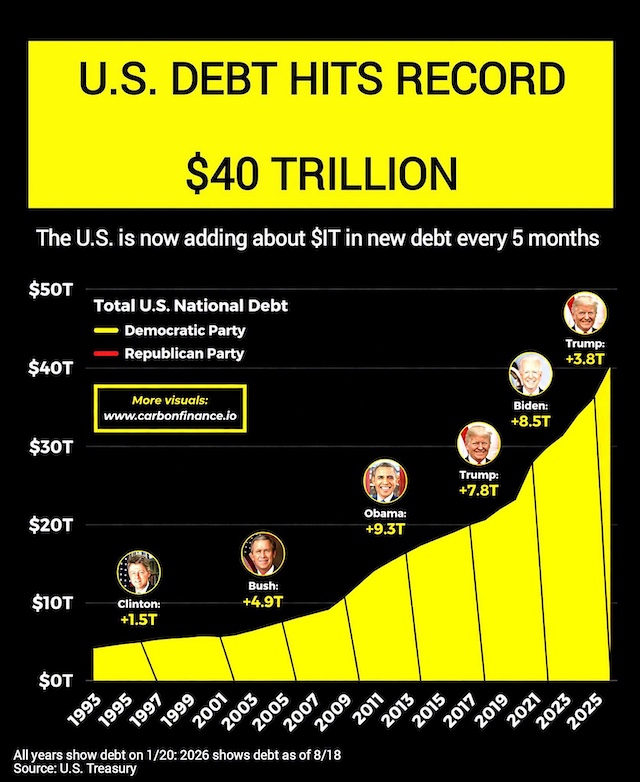 This debt didn’t spring up overnight, and it sure didn’t belong to one party or the other. Both sides have been like a couple of boys with a cookie jar, each blaming the other while both keep dipping their hands in. Spend first, figure out how to pay later — that’s been the rule for decades. The result is a mountain of IOUs that our children and grandchildren will have to climb.
There’s talk these days about “affordability,” as if it were some new disease invented last week. It ain’t. It’s the leftover from years of printing and spending more money than the country produced. You can’t inflate the currency for half a decade and then act surprised when ordinary people feel poorer. The only honest way to climb back is the hard way: stop the spending binge, grow the real economy so the debt becomes a smaller share of the whole, and let wages catch up without the government trying to manage every price and every paycheck.
Looking down the road to 2035, if both parties keep on the way they’ve been going — promising everything, paying for nothing, and kicking the can further down the road — the arithmetic gets mean. Interest on the debt could double. More and more of every tax dollar will go just to service the old borrowing instead of roads, defense, or anything useful. Foreigners who hold a lot of our paper might start selling, rates would shoot higher, and the whole machine could seize up. We’ve seen smaller versions of that movie before, and it never ends with free ice cream for everybody.

Broken bones…
The good news is that America still has the bones of a strong country — hard-working people, invention, energy in the ground, and a habit of fixing things when the pain gets bad enough.
Markets work better than committees when you leave them alone. Property rights, honest contracts, and limited government have always been the soil that grows real prosperity. But soil doesn’t stay fertile if you keep pouring salt on it year after year.
So here’s the plain truth, neighbor: the economy is still standing and even walking forward in places, but it’s carrying a load that grows heavier every day. The politicians of both stripes have been too busy arguing over who gets the credit and who gets the blame to do the one hard thing that would actually help — stop spending money we don’t have. If they don’t change course, by 2035 a lot of the freedom and plenty we’ve taken for granted will be harder to find.
The choice is still ours, but the clock is ticking louder than most folks in Washington seem willing to admit.
October 6, 2026

Justin O. Smith ~ Author
~ the Author ~
Justin O. Smith Has Lived in Tennessee Off and on Most of His Adult Life, and Graduated From Middle Tennessee State University in 1980, With a B.S. And a Double Major in International Relations and Cultural Geography – Minors in Military Science and English, for What Its Worth. His Real Education Started From That Point on. Smith Is a Frequent Contributor to the Family of Kettle Moraine Publications.