 Well … here it is my friends – that longer, dry, crisp, hard, factual analysis and assessment on the current state of America’s economy such as it is, along with the reasons that so many Americans still feel like they’re drowning even as Trump and Bessent assure us all this is “the Greatest Economy Evah” and “Americans are living in a Golden Age“, which makes me want to puke for a litany of reasons.
There comes a time in the life of every country when an old man ought to quit worrying about whether anybody wants to hear what he has to say and say it anyway. I reckon I have reached that particular age.
I have lived long enough to see good times and bad times, wars and peace, presidents come and presidents go, dollars that bought something and dollars that seemed to disappear from a fellow’s pocket before he could get them home. I have watched Americans build things that the rest of the world said could not be built, and I have watched Washington promise things that nobody in his right mind could possibly afford. I have seen hardworking people get up before daylight, work until dark, raise families, pay their bills and put a little something away for a rainy day, while the folks running the national government somehow managed to spend money faster than a drunken sailor with somebody else’s credit card. So let me tell you something about this American economy as plainly as I know how: America is not broke, but America is borrowing like a man who has forgotten that sooner or later somebody is going to come knocking on his door.
The Democrats didn’t invent foolish spending, and the Republicans didn’t invent fiscal responsibility. Neither party has a monopoly on wisdom, and neither has a monopoly on foolishness. If you have lived through enough election seasons, you eventually discover that politicians have a remarkable talent for describing the same cow from opposite sides of the pasture. One fellow will tell you the animal is magnificent because it produces milk. The other will tell you it is a disaster because it leaves manure behind. Both may be telling the truth, but neither is giving you the whole story. The American economy is a good deal like that cow. It is still producing. It is still working. It is still feeding a great many people. But there is an awful lot of manure in the barn, and sooner or later somebody is going to have to clean it out. ~ J.O.S.
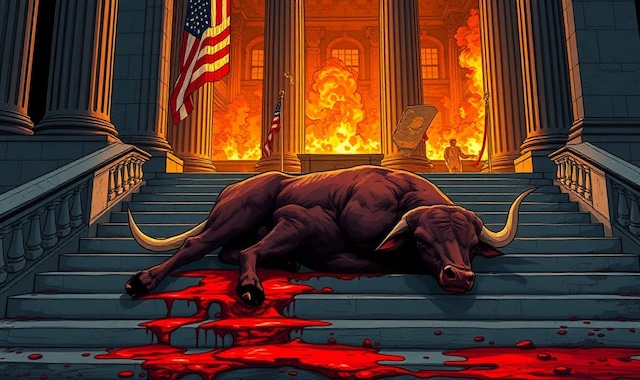
The American People Left to Pay the Bill ~ $64 TRILLION by 2036!
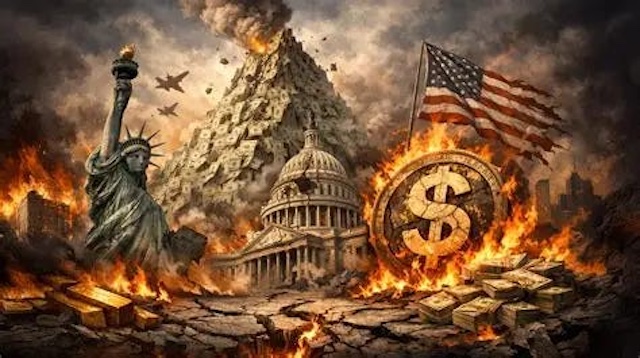 There is a curious habit in American politics these days of describing the economy as though it were either a magnificent thoroughbred galloping toward a glorious sunrise or a corpse already lying stiff in the ditch, depending upon which political party happens to be holding the microphone. Both descriptions are nonsense. The American economy in October 2026 is neither a miracle nor a funeral. It is a remarkably productive, innovative and resilient economic machine carrying a fiscal load that would have caused previous generations of politicians to reach instinctively for the smelling salts.
The United States still possesses extraordinary advantages: the deepest capital markets on earth, abundant energy resources, enormous agricultural and industrial capacity, world-leading technology companies, a highly productive workforce, the dollar’s unique international position and an entrepreneurial culture that continues to create wealth despite Washington’s best efforts to complicate the process. Real GDP grew 2.1 percent in the first quarter of 2026 and 1.5 percent in the second, according to the Bureau of Economic Analysis, while corporate profits and household net worth remain substantial. The Federal Reserve reported that household and nonprofit net worth reached $195.9 trillion in the second quarter, an increase of $12.8 trillion in three months, largely because of gains in corporate equities.
The American economic animal is therefore very much alive. But anyone who looks at those numbers and concludes that everything is wonderful ought to spend an afternoon talking to somebody trying to buy a first house, fill a grocery cart, insure an automobile or raise children on an ordinary paycheck. That person may have a rather different economic report.
The first thing Washington needs to stop doing is confusing a lower inflation rate with lower prices. Inflation is the rate at which prices rise; it is not a magic eraser that returns prices to yesterday’s level. The Bureau of Labor Statistics reported that consumer prices were still rising at a 3.4 percent annual rate in August 2026, with gasoline prices rising 3.9 percent in that month alone and shelter continuing to increase. More importantly, the price level is dramatically higher than it was before the pandemic-era inflation explosion. That means the fellow who was paying $100 for something several years ago does not suddenly get to pay $100 again because Washington announces that inflation has “fallen.” If the price becomes $130 and inflation subsequently falls from eight percent to three percent, he is still paying approximately $130.
The government has merely slowed the speed at which the next robbery occurs. This distinction is not academic. It is the difference between what economists call disinflation and what a working man calls, “Why the hell does everything still cost so much?”
The affordability problem therefore is real, even when many headline economic indicators are positive. Republicans are right that much of the inflationary damage occurred before Donald Trump’s second term; Democrats are right that families are still living with the consequences. The honest answer is that the American household does not care which administration gets the blame when the grocery receipt arrives.
And here is where the official economic picture becomes both true and misleading at the same time. Americans are still spending. In August, personal consumption expenditures increased by $190.8 billion, or 0.9 percent, while personal income rose only $66.6 billion. The personal saving rate fell to 4.1 percent. Those numbers can be advertised as proof of a vigorous consumer. They can also be interpreted as evidence that households are paying more for the necessities of life while having less room left over afterward. Both observations can be true. If a family spends $200 on groceries where it once spent $150, consumer spending has increased by 33 percent without the family becoming 33 percent wealthier. It may simply be buying the same groceries at a higher price. That is why aggregate consumption should never be treated as a perfect substitute for household prosperity. A man can spend more while becoming poorer, just as a government can spend more while producing no additional wealth. The receipt does not care about political rhetoric.
The labor market tells a similar story. The unemployment rate was 4.2 percent in September 2026, which by historical standards is low, but payroll employment increased by only 29,000 that month, according to the latest BLS report. That is not a collapse, but neither is it evidence of an economy creating jobs at a breathtaking pace. The employment picture is therefore better described as resilient but slowing. And that matters because a healthy economy is ultimately not a stock-market chart; it is millions of people going to work, producing things, providing services, earning wages and building businesses. Wall Street can rise while Main Street struggles, because ownership of financial assets is highly concentrated. The Federal Reserve’s financial accounts show just how enormous the nation’s aggregate wealth has become, but aggregate wealth is not distributed evenly, and the existence of $195.9 trillion in household net worth does not mean that every American household has a comfortable share of it. A millionaire’s rising portfolio does not pay a mechanic’s rent.
That brings us to the great deception perpetrated by both parties: each wants Americans to believe that the economic statistics prove its political story. Democrats frequently point to affordability, inequality and household anxiety as though these prove that capitalism itself has failed. Republicans point to GDP, employment, stock prices, investment and business confidence as though these prove that everything is already fixed. Neither argument is sufficient. Capitalism did not create the federal government’s $40 trillion debt. Congress did — with the first Trump administration and the Biden regime adding $15 trillion to it, almost evenly split between them.
The free market did not force Washington to spend beyond its revenues for decades. Politicians did. But neither can Republicans honestly pretend that deregulation and economic growth alone will solve the fiscal arithmetic, because no amount of cheerful press releases can repeal compound interest.
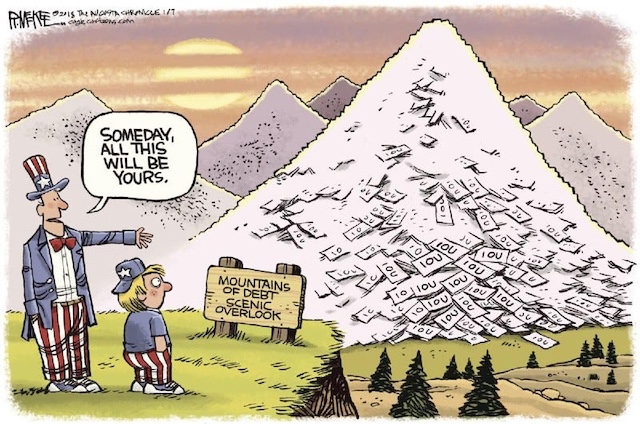
That arithmetic is now the great fact looming behind everything else. The national debt crossed approximately $40.2 trillion at the beginning of fiscal year 2027. Yet the more economically meaningful number is debt held by the public. The Congressional Budget Office projects that debt held by the public will rise from about 101 percent of GDP in 2026 to 120 percent in 2036. Under current law, CBO projects federal deficits of $1.9 trillion in 2026 and $3.1 trillion in 2036. Net interest alone is projected to rise from roughly $1 trillion in 2026 to $2.1 trillion in 2036. Read that again slowly. Washington will not merely owe more money; an increasingly large portion of every federal dollar will be devoted to servicing yesterday’s promises rather than paying for today’s necessities. That is what a debt trap looks like before the trap snaps shut.
The uncomfortable truth is that America does not need to “pay off” forty trillion dollars in the manner a family pays off a mortgage. Sovereign governments routinely refinance debt, and the United States has an enormous economy capable of supporting very large quantities of debt. The real danger is whether debt grows faster than the nation’s capacity and willingness to service it. CBO’s projections provide the warning without requiring any doomsday website or financial prophet. From 2026 through 2036, CBO projects another $26 trillion of borrowing, bringing debt held by the public to roughly $56 trillion and gross federal debt to approximately $64 trillion by 2036. At that point interest costs alone would consume approximately 4.6 percent of GDP and nearly one-fifth of federal spending. That is not an imaginary apocalypse. It is the government’s own baseline arithmetic.
As reported by The Wall Street Journal on October 1st 2026:
“President Trump said ‘certain levels of inflation’ could help pay down the national debt ‘very rapidly’ in an interview with Time magazine where he also said the Federal Reserve’s interest-rate policy is hurting the economy more than inflation is.
Trump accused the Fed’s rate-setting committee of acting out of spite toward him, twice accusing officials of ‘Trump derangement syndrome,’ while sparing his pick, Fed Chairman Kevin Warsh, from blame for last month’s interest-rate increase.”
And here is the part Washington habitually avoids discussing: the problem is not simply Republicans versus Democrats. Both parties have discovered that spending money is politically easier than telling citizens that government cannot provide every benefit, subsidy, tax preference, military program, retirement promise, healthcare commitment and bureaucratic enterprise that somebody has promised them. Democrats generally want a larger government financed by higher taxes and borrowing. Republicans generally want lower taxes while retaining much of the spending, adding defense spending and occasionally inventing new programs of their own. One side says, “Tax the rich.” The other says, “Cut taxes.” Both then discover that cutting the actual machinery of government is remarkably unpopular once somebody’s particular constituency discovers that its particular machinery is about to be cut. Thus the national credit card remains in the drawer, and Congress keeps finding reasons to swipe it.
The fiscal danger is compounded by demographics. Social Security and Medicare are not temporary wartime programs that can simply be allowed to expire. They represent promises made to millions of Americans, many of whom structured their lives around those promises. Yet an aging population means that the number of beneficiaries grows relative to the number of workers supporting the system. CBO projects that Social Security’s Old-Age and Survivors Insurance trust fund will be exhausted in 2032 under current projections. That does not mean Social Security disappears in 2032. It means the government faces a politically painful choice among benefit reductions, higher taxes, borrowing, altered eligibility, or some combination thereof. Politicians will probably postpone the unpleasant decision as long as humanly possible, because postponement is one of Washington’s few truly bipartisan accomplishments.
This is why the notion that America is about to experience some predetermined “collapse” on a specific date should be rejected. Economies rarely collapse according to a calendar hanging on the refrigerator. A fiscal crisis arrives when confidence changes, when interest costs become politically intolerable, when investors demand higher compensation for risk, when inflation expectations become entrenched, when monetary policy becomes trapped between protecting the currency and protecting the government’s ability to finance itself, or when some unrelated financial shock exposes the weakness underneath.
 The CBO’s September 2026 analysis demonstrates how sensitive the long-term picture becomes when interest rates rise. Under a scenario in which interest rates are one percentage point higher than its extended baseline, CBO projects debt held by the public reaching 222 percent of GDP by 2056 rather than 175 percent. That is the important lesson: the danger is not one particular number. The danger is the interaction between debt, interest rates, economic growth and political unwillingness to make difficult choices.
America nevertheless possesses something that most debt-ridden nations would desperately like to own: an astonishingly productive private economy. American businesses continue to innovate. Manufacturing investment has surged. Energy production remains enormous. The United States remains a dominant destination for global capital. Technology, pharmaceuticals, aerospace, finance, agriculture, energy and advanced manufacturing all retain extraordinary productive capacity. The Federal Reserve’s household balance-sheet data alone demonstrate the vast quantity of real and financial wealth that exists beneath the federal government’s liabilities. This is precisely why America should not be written off. The nation is not poor. Washington is simply consuming too much of what a wealthy nation produces.
That distinction also explains the strange spectacle of a nation that can simultaneously be called prosperous and unaffordable. America has enough wealth to make almost anything possible, but government spending does not create wealth merely because the Treasury writes a check. Government can redistribute wealth, regulate it, tax it, borrow against it and sometimes destroy it. Wealth itself comes from people producing goods and services that other people value. That old-fashioned proposition remains true regardless of whether the production takes place in a Tennessee machine shop, a Texas oil field, an Ohio factory, a California laboratory or a software company in Silicon Valley. The real economic miracle is not Washington spending money. It is an American citizen getting up tomorrow morning, taking a risk, building something useful and voluntarily persuading another human being to pay for it.
So what should Americans expect between now and 2035 if Washington refuses to change course? Probably not an instantaneous Mad Max collapse with ATMs turning into flowerpots on some predetermined Tuesday. Something more mundane — and potentially more dangerous — is likely. Debt will continue climbing. Interest will consume an increasing share of federal resources. Taxes will face upward pressure. Inflation may periodically return whenever fiscal and monetary policy become too loose. Interest rates could remain structurally higher than Americans became accustomed to during the post-2008 era. Housing will remain difficult so long as supply restrictions, high construction costs, land-use regulations and financing costs keep prices elevated. Younger Americans will increasingly discover that the traditional milestones of adulthood — owning a home, raising a family, saving for retirement — require a larger income and more sacrifice than they did for their parents. And every recession will become more politically dangerous because Washington will enter it already carrying a mountain of debt.
By 2035, if the current trajectory remains substantially unchanged, the United States could still be one of the world’s richest and most powerful nations while simultaneously suffering a considerably weaker fiscal position. That apparent contradiction is precisely what makes the problem so difficult to recognize. The Titanic did not become dangerous because the ship suddenly became unseaworthy. It became dangerous because a magnificent ship was carrying itself toward an obstacle faster than its ability to change course. America has the productive capacity to remain prosperous. What it does not possess is an unlimited ability to borrow without consequence.
The CBO’s baseline already shows debt held by the public reaching 120 percent of GDP in 2036, with interest costs more than doubling in nominal terms over the decade. The mathematics do not care whether the president is a Republican or Democrat, whether Congress is red or blue, or whether cable television declares the economy wonderful or disastrous.
The cure is therefore neither socialism nor some magical return to a mythical economic past. It is something considerably less glamorous: spending less than we borrow, restraining the growth of entitlement programs before arithmetic forces much harsher reductions, eliminating genuinely wasteful programs, reforming taxes without pretending that tax cuts pay for themselves automatically, encouraging energy production and private investment, reducing unnecessary regulation, restoring incentives to work and save, and refusing to treat every political constituency as entitled to a federal subsidy. Above all, government must return to the principle that made the American experiment extraordinary in the first place: the government exists to protect the conditions under which free people can produce prosperity, not to manufacture prosperity for them.
There is an old American superstition that prosperity can be legislated into existence. It cannot. There is another superstition that government can borrow indefinitely because America is “too big to fail.” History has buried empires considerably larger than most people imagined possible. The United States is not immune from arithmetic. But neither is it helpless. The same country that built an industrial giant from farms, crossed a continent with railroads, put men on the Moon, transformed agriculture, invented industries that did not exist when our grandparents were born and repeatedly rebuilt itself after wars, depressions and financial panics still possesses the capacity to correct its course. The question is whether its politicians possess the courage to tell the American people the truth before the bond market tells them instead.

THIS makes No Sense
That is the real economic story of America in 2026. The patient is not dead, not yet. The patient is extraordinarily strong, productive and wealthy. But the patient has been eating too much, borrowing too much, promising too much and pretending for too long that tomorrow’s bill is somebody else’s problem. The stock market can rise. GDP can grow. Jobs can be created. Wages can increase. Businesses can invest. All of that can be true—and the fiscal trajectory can still be unsustainable.
The United States therefore faces neither an inevitable collapse nor an excuse for complacency. It faces a choice. Between now and 2035, Americans can demand that both political parties finally confront the arithmetic and restore government to a size compatible with economic liberty, or they can continue applauding while Washington spends tomorrow’s money today. If they choose the latter, the bill will eventually arrive. And when it does, Uncle Sam will not be the one paying it. The American people will.
October 9, 2026

Justin O. Smith ~ Author
~ the Author ~
Justin O. Smith Has Lived in Tennessee Off and on Most of His Adult Life, and Graduated From Middle Tennessee State University in 1980, With a B.S. And a Double Major in International Relations and Cultural Geography – Minors in Military Science and English, for What Its Worth. His Real Education Started From That Point on. Smith Is a Frequent Contributor to the Family of Kettle Moraine Publications.