Former Wall Street Watchdog Sounds the Alarm on Market Crash That Could Trigger a Recession by 2028 – Time to ‘Batten Down the Hatches’
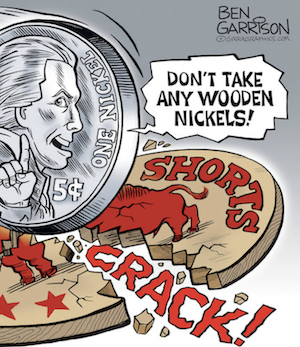
 The artificial intelligence gold rush could be heading for a spectacular crash, with a former Wall Street regulator warning that the fallout could plunge the US into recession before the next presidential election.
Gary Gensler, who chaired the Securities and Exchange Commission between 2021 and 2025, believes the extraordinary investment pouring into AI has created a dangerous financial bubble.
‘It’s already a bubble,’ he told CNN, warning that the industry could be approaching a painful turning point.
The major companies will survive,’ he said, predicting that smaller players could experience ‘some breakage and bankruptcies’.
He expects a potential AI crash to be comparable in scale to the dot-com bust of the early 2000s, although he does not believe it would be as devastating as the 2008 mortgage crisis.
Crucially, he warned that the economic fallout could arrive at a politically sensitive moment, ahead of the November 2028 presidential election.
‘I think we’re going to have this repricing and a softening of the economy that happens before November 2028,’ he said…. (Continue to full article)
The U.S. Economy Is Ripping
 The Big Picture: Growth was even stronger this summer than it appeared, and the robust expansion is continuing this fall, according to a range of data released Wednesday morning. That is pushing Americans’ incomes up and the pace of layoffs down.
The U.S. economy grew at a 4.3% annual rate in the July-through-September quarter, according to the second revision to GDP data — well above the 3.4% originally reported.
The strong results have continued into Q4. The Commerce Department separately said that personal income rose 0.7% in October, well ahead of analysts’ expectations.
Overall orders for durable goods came in below forecasts for October, but core capital goods orders — a forward-looking measure of investment spending — climbed 1.2%, also well ahead of projections.
The Labor Department said that only 189,000 people filed new claims for jobless benefits last week, matching the lowest of 2026 and among the lowest readings on record (claims go back to 1967).
The strong growth readings affirm the Fed’s all-but-certain plans to raise interest rates at a meeting concluding Dec. 9. Inflation data also released in the report shows why… (Continue to full article)
Banks Add Up All the Cash a Customer Deposits or Withdraws in a Single Day, and a Total Over $10,000 Triggers a Federal Currency Transaction Report
 A bank does not look at one deposit at a time. Federal rules make it add up every cash deposit and every cash withdrawal a customer makes in a single business day, and if the total goes over $10,000, the bank has to file a Currency Transaction Report with the Treasury Department. The bank files it on its own, and the customer does not have to do anything to set it off.
FinCEN, the Treasury bureau that collects the reports, says a report is required for cash transactions over $10,000 “conducted by, or on behalf of, one person.” It adds that “multiple currency transactions that aggregate to be over $10,000 in a single day” count too, and it calls the form a CTR.
The federal regulation behind this says a bank includes all of its domestic branches. Under 31 CFR 1010.313, several cash transactions are treated as a single transaction when the bank knows they are by or on behalf of the same person and they total more than $10,000 in cash in or cash out in one business day. A deposit dropped in a night depository or made over a weekend or holiday counts as received on the next business day, according to the regulation.
Say a customer deposits $4,000 in cash at a branch in the morning, $3,500 at a second branch at lunch and $3,000 at a third branch after work. Each deposit is under $10,000. Together they come to $10,500, and the bank counts them as one transaction for that business day.
Cash coming out is added up the same way, and cash in and cash out are totaled separately. Under the regulation, the test is more than $10,000 in cash in or more than $10,000 in cash out. A customer who deposits $6,000 and withdraws $6,000 on the same day has not crossed the line on either side, going by the regulation’s wording… (Continue to full article)
Silver Prices Exploded 8% Overnight While Wall Street Was Closed for Thanksgiving
 Silver futures rose about 8% in the CME’s Thursday-night session on Nov. 26, 2026, while U.S. stock markets were closed for Thanksgiving. At 11:38 p.m. ET, the March 2027 contract traded at $43.74, up $3.20, or 7.90%, from Wednesday’s $40.538 settlement. Its session high was $44.005, up 8.55%.
The move came in thin holiday trading, and these quotes will change before Friday’s settlement and the 9:30 a.m. ET stock open. There is no Thursday settlement, so gains are measured from Wednesday’s close.
March is the contract to follow because 46,213 contracts traded Thursday night, against about 5,900 in December. December silver stood at $43.22, up 7.89%, at about 11:38 p.m. ET.
The whole complex rose with it. February gold reached $3,663.80, up 2.78%, while January platinum gained 6.52%, December palladium 7.30% and March copper 4.00%.
The turn came fast, because March silver touched $38.42 on Wednesday. An earlier update had silver up 5.2% at $43.66, with gold little changed at $3,567.60… (Continue to full article)
Gold’s Biggest Challenge Is No Longer The Fed, Says Economist Robin Brooks.

‘We Are Back To Oil As Growing concerns over the AI sector could weaken the U.S. economy, reducing the case for further interest rate hikes’
The economist estimates that a 10% jump in Brent crude prices could trigger a 4% decline in gold. Traders are pricing in a 99.2% probability of another quarter-point hike in December, compared to 88.6% a week ago.
Economist Robin Brooks believes the Federal Reserve’s hawkish stance has already been played out as a catalyst for gold, with bullion’s near-term outlook now depending on the “hot” war.
In a Substack post on Friday, Brooks said he was “shocked by this month’s fall in gold prices,” noting that rising real interest rates accounted for only a small portion of the losses. “Real rates have plateaued, which is just another way of saying that Fed hawkishness is close to maxed out.”
Spot gold fell nearly 8% this month through Thursday. At the time of writing, it was up 1.75% to $3,628.94 per ounce. Gold futures expiring in January 2027 jumped 2.7% to $3,646.20 per ounce.
Brooks Says Further Rate Hikes Unlikely… (Continue to full article)