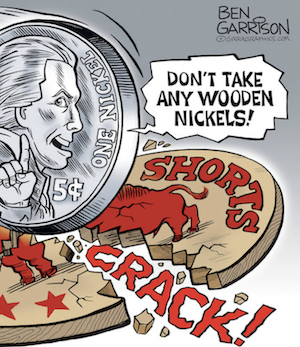
Plummeting Copper Prices Signal the US Economy May Be Heading for a Rough Patch
 Copper’s latest decline has analysts worried about the strength of the US economy. The metal, which is viewed as an economic bellwether, is down 17% from its recent high. Copper’s price is tied to industrial activity, which is why it’s seen as a growth indicator.
The plunge in copper might be a big warning for the economy.
Copper, one of last year’s hottest investments, is in the midst of a sharp decline, a trend that’s starting to worry more forecasters about what it’s saying about the US economy. The metal is known to be a quiet economic bellwether, given that it’s a reflection of industrial activity, and its price moves often follow changes in construction and manufacturing.
Copper has no opinions and tells no stories. It sits in the wiring of every house, the motor of every car, the transformer at the end of every street and the compressor of every air conditioner… (Continue to full article)
Why You Should Invest in Gold for 2027
 Waiting for the price to fall further could be risky as gold has less volatility than alternative metals like silver. And, with multiple factors in play that easily cause the price to surge again, it makes sense to get invested now, when there’s still an affordable entry price point to take advantage of.
The end of the year is often an opportune time to revisit your financial health. What’s been working effectively over the previous 12 months, after all, may not be the same heading into 2027. A new approach, new insurance protections and, potentially, new and different investment strategies all may now be in play in a way that seemed unlikely at the start of 2026. For many Americans, that could mean exploring alternative assets that they may not have considered before, like gold.
And it may not even have to be expensive. The price of gold has been particularly volatile this year but the numerous records it broke in 2025 continue to make it a viable investment for many, especially now that inflation is rising again, alongside other economic concerns growing in prominence. In fact, 2027 could be one of the better years in recent memory to get invested in the yellow metal. Below, we’ll outline three specific reasons why it could be worth investing in for the new year.
Adding a moderate portion of gold to your portfolio could make sense for the upcoming year, and potentially further. Here’s why… (Continue to full article)
Gold poised to hit $18K amid US debt bloodbath, market expert says
 Gold has continued its dramatic slide, dipping to a spot price of about $3,549 per ounce as of Nov. 20 (1). Yet one market expert thinks the yellow metal could someday hit $18,000 an ounce.
Despite gold prices coming down from their peaks in early 2026, investors’ appetite for the precious metal appears strong.
Gold backed exchange traded funds (ETFs) saw inflows in October (5) for the fourth consecutive month, according to the World Gold Council (WGC). In the first 10 months of 2026, gold ETF holdings increased by 246 tonnes.
Central banks are active gold buyers, too.
They bought 321.2 tonnes of gold in the third quarter of 2026, up 42% year-over-year. Their gold buying year-to-date has increased above 2025, according to the WGC (6).
the situation could be negative for gold in the near term. He only expects his scenarios to play out over the intermediate to long-term, especially if the real interest rates keep climbing.
Still, his gold forecast and warning about a fiscal crisis for the U.S. raise two very important questions. Is your portfolio ready if a crisis hits and market volatility follows? And if gold prices skyrocket, will your nest egg be positioned to benefit from it?
Shockproof your cash now (and build a fat nest egg)…(Continue to full article)
This Is the Time to Buy Gold, Not Sell It
 Gold just went through its rockiest stretch of the year, and Fast Money regular Tim Seymour sees a buying opportunity. On CNBC’s Fast Money on Nov. 20, 2026, he said the selling has more to do with how investors are invested than with gold itself:
“Gold has not been a safety trade for quite some time. I think it’s a funding trade right now. People are probably selling it to settle margin calls. Of all the things I might be selling in a growth scare, this is the time to buy gold, not sell it.”
Some pressure is building, though. Management expects fourth-quarter costs of $1.9 thousand per ounce, the highest of the year, and warned that unit costs will trend higher in 2027. When Newmont originally set its 2026 guidance, it assumed gold at $4,500/oz, and spot gold now trades well below that level.
Gold pays no interest or dividends, which matters for retirees who live off their portfolios. What it offers is diversification. Gold tends to respond to central bank buying, currency moves, and geopolitical stress, forces that often move stocks and bonds differently. This year shows how volatile it can be: anyone who bought near January’s peak is now sitting on a deep loss.
But NOW is the time to take advantage of it’s decline… (Continue to full article)
[Got physical… close at hand?]
Let’s do something about that…


Click on IMAGE
Call Jeffrey Bennett (Kettle Moraine, Ltd.) who has over 35 years experience in the precious metals markets – first as an investor and subsequently – with over 30 years as a respected member of the industry for guidance and assistance with your needs.
Kettle Moraine, Ltd.
P.O. Box 579
Litchfield Park, AZ 85340
602-799-8214
kettlemoraineltd@cox.net