3 Easy Ways to Reduce Pain at the Pump
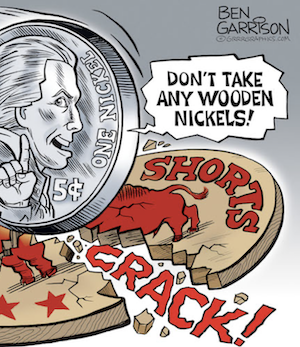
 I’ve always argued that the easiest way for families to gauge the health of the economy is to check the daily gas price. Drivers see the 50-foot-high signs in every community in America. They stare us right in the face.
I call it the affordability index.
In recent weeks, gas prices have hit $4.50 a gallon nationally, and truckers are paying well over $6 a gallon.
That’s a bad look with a month to go before midterm elections across the country. These high prices have put consumers in a bad mood.
It’s worth mentioning that the average gas price while Donald Trump has been president is lower than the average price under former Presidents Barack Obama and Joe Biden. But when it comes to affordability, voters ask: “What have you done for me lately???” (Continue to full article)
Pennsylvania Police Say Fake Federal Agents Have Stolen $6.5 Million in Gold Bars From Americans Across Multiple States
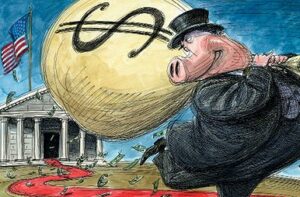
 A pop-up on your computer probably doesn’t signal to you the possibility of a scam that could wipe out your savings. But Pennsylvania State Police say that’s how a fraud scheme spreading across several states started, with victims eventually being convinced to turn their cash into gold and hand it over to strangers.
Police stated that about $6.5 million has already been stolen (1), and they believe there could be more victims who haven’t come forward.
The scheme is particularly unsettling because the people behind it aren’t simply asking for money over the phone. They’re pretending to be federal law enforcement officers and telling victims their own identities and bank accounts are caught up in criminal activity.
WARNING!!! ~ The scam starts with a warning on your computer
According to Pennsylvania State Police, the scheme typically begins with a pop-up appearing on the victim’s computer. The victim is then contacted by somebody claiming to be a federal official.
The caller may say the victim’s Social Security number has been connected to a criminal investigation or that their financial and personal information has been compromised. The goal is to convince the person that their money is in danger… (Continue to full article)
Debt Arising from Central Bank Credit Leads to Economic Crises
 According to many economic commentators and various experts, the high level of debt, which surpassed the $40 trillion in August this year, is a major threat to the US economy. A view that debt could pose a threat to the economy originates from the writings of American economist Irving Fisher.
According to Fisher, a major risk is debt liquidation. Fisher was of the view that debt liquidation could cause a decline in the money supply. This decline, in turn, is likely to cause a decline in the prices of goods and services, called deflation, and, in turn, produces an economic slump. According to Fisher, the trigger for this could be a shock such as a large decline in the stock market.
Why however should debt liquidation cause a decline in the money supply? Take a producer of consumer goods who consumes part of his produce and saves the rest. In the market economy, the producer could exchange the saved goods for money. He could then decide to lend his money to another producer. By lending the money, the lender transfers his savings to a borrower for the duration of the lending contract. By means of money, the borrower could now purchase consumer goods to support his life and wellbeing.
Once the contract expires on the date of maturity, the borrower returns the money to the original lender. The repayment of the debt, or the debt liquidation, does not have any effect here on the supply of money… (Continue to full article)
Government Should Liquidate Itself
 This should surprise no one: The Social Security Trust Fund is expected to run dry by 2032, at which point benefits will be slashed or taxes increased. Since slashing benefits is political suicide, we can expect Congress to swing into action as the perennial champion of a politically powerful voting bloc.
Like government as such, Social Security is akin to the “Too Big To Fail” mantra that powerful banks have secured for themselves. For these systemic financial institutions Dodd-Frank will not, as promised, take taxpayers off the hook for saving them. The problem is the problem will never go away, absent radical action. Government will keep sending Social Security checks while changing who pays them, when they may be collected, how much they buy, or all three.
Social Security is a claim on a person’s income – any working person. Did this person agree to it? Today, it would strike most people as strange even to ask the question.
A wartime emergency that prompted the Current Tax Payment Act of 1943 has allowed government to loot paychecks before earners even see them… (Continue to full article)
Food Shortages In 2027? The ICC Warns That Global Food Prices Could Rise By Close To 70% – I Asked AI What Would Happen Next
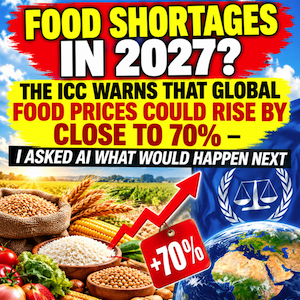 All over social media, people want to know if there will be food shortages in 2027. Coming into this year, the UN was warning that global hunger had reached an unprecedented level. Now we are facing a global fertilizer crisis, a global energy crisis, widespread droughts, a Super El Niño and World War III all at the same time. Of course global hunger is going to get even worse in the months ahead. Nobody can deny that.
Wealthy nations such as the United States will theoretically be in the best shape, but even here in the U.S. approximately 1 out of every 7 people already live in food insecure households. Rapidly rising food prices will definitely be very painful for us, but for millions of people that live in deeply impoverished countries much higher food prices could suddenly make it impossible for them to buy enough food to properly feed their families.
How would you feel if members of your family were extremely hungry but you didn’t have anything to give them?
For many of us, that would be unimaginable.
Unfortunately, such a scenario could soon become a reality in needy households all over the planet… (Continue to full article)


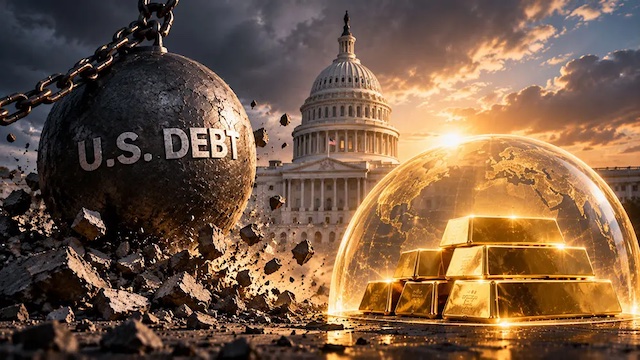 The Federal Reserve’s commitment to bring inflation down to its 2% target is creating some much-needed confidence in the long end of the yield curve as 10-year bond yields fall back below 5.00%; however, according to one fund manager, gold remains the ultimate safe-haven insurance play.
 Warren Buffett has a ‘big worry’ over the US dollar ‘really going to hell’ — warns fiscal policy is what really scares him in America.
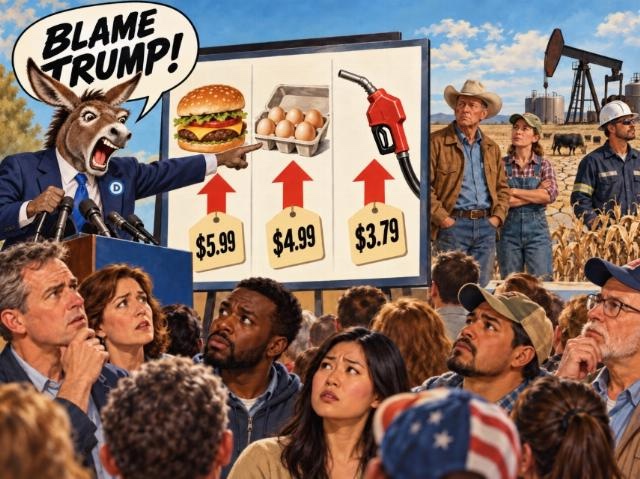 The food affordability histrionics surrounding hamburger prices are an interesting example of left-wing hyperbole directed at Donald Trump about a serious long-term problem that the Left has no plans to fix. Like egg and gasoline prices, the goal is to sow midterm angst and fear, regardless of whether President Trump caused the problem, has the power to fix it, or whether the problem is fixable at all. This cynical pattern is profoundly dangerous.
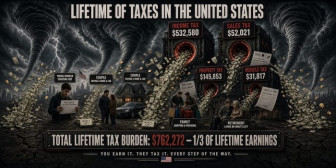 Americans persistently say that taxes are too high. In a 2024 Gallup poll, 59% of adults say that the tax burden in America is excessive. That 60% number has been constant for several years. The Trump federal tax cuts and trimming of government have been welcome and certainly going in the right direction, but state tax liability never seems to come down. It only gets worse.
 According to the 2026 Trustees Report, the Social Security retirement trust fund is projected to run out by 2032 when it becomes insolvent, impacting more than 60 million Americans.
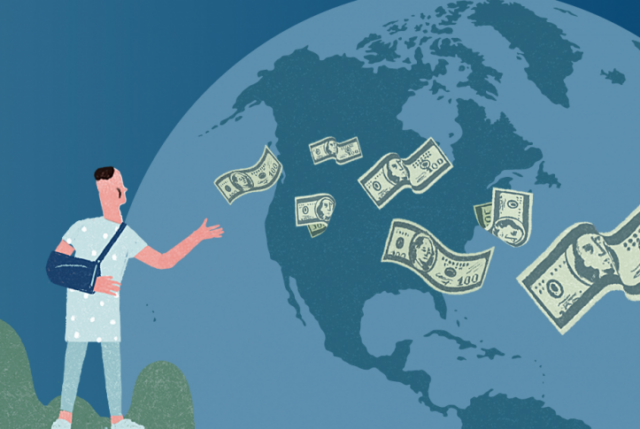 A survey of employers projects the largest increase in healthcare costs in more than two decades, driven by factors including the growing use of expensive weight-loss drugs and artificial intelligence tools that help medical providers submit more billable claims.
 Social Security has been on a well-documented path toward a funding shortfall for years, but the policies enacted and proposed during the Trump administration have accelerated that timeline in ways that deserve more attention than they’ve received.
 The Netherlands has moved 86 tonnes of its gold stock out of the US and Canada to London due to ‘increasing geopolitical unrest’.

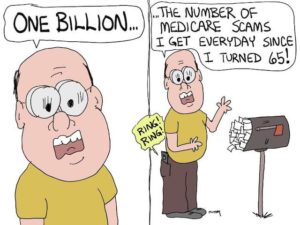 The retreat from Medicare Advantage is no longer coming only from insurers. This year, hospitals and doctor groups have started walking away too. At least 25 health systems across the country have dropped or declined to renew Medicare Advantage contracts in 2026, and in some cases the exit took effect on roughly 30 days’ notice, cutting patients off from in-network access in the middle of a plan year. It is a quieter story than an insurer pulling a plan, but for a patient mid-treatment it can be just as disruptive.
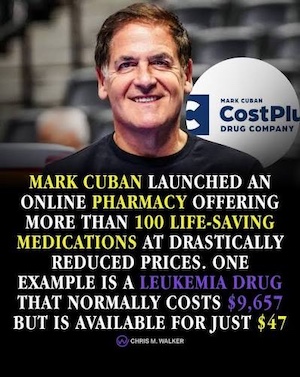 In 2025, Americans spent $5.6 trillion on health care, and that number is projected to climb to as much as $8.6 trillion by 2033. For some patients, the biggest financial burden comes after their insurance claim is denied.
 Copper has spent 2026 rewriting its own history books. In early August, the metal pushed above $14,300 per tonne on the London Metal Exchange, a fresh all-time high extending a rally few expected to run this far, this fast.
 Sen. Rand Paul (R-Ky.) toured Fort Knox to inspect the gold reserves on Monday, voicing concerns over the diminishing purchasing power of the dollar.