The U.S. national debt is projected to hit the $40 trillion milestone by the end of this month. The cost to service that debt will cost approximately $3.18 billion per day, according to Congressional Budget Office.
Since big government loves to spend, the debt will only snowball with greater alacrity.Continue reading →
Posted inLet's Get Physical|Comments Off on Garrison: The National Debt Keeps Growing
Through the ongoing process of exchange, people eventually settled on gold as their preferred medium of exchange. Some commentators cast doubt that gold could fulfill the role of money in the modern world. It is held that, relative to the growing demand for money because of growing economies, the supply of gold is not growing fast enough. ~ According to Insider from June 15, 2011,
“The basic problem is that the supply of gold is not related to the quantity of goods and services being produced. . . . As a result of this scarcity, prices decline. Individuals have less incentive to produce new goods and services. Economic growth is stifled. Allowing money to become scarce does the greatest harm to those who have the least. In the past, the relative inflexibility of the monetary system contributed to the chronic lack of growth in many of the world’s less developed countries. Since the 1970s, we have had one of the most flexible monetary systems the world has known, and many of these countries have flourished. With a flexible monetary system, more money can be created to accommodate more growth.”
In this way of thinking, the free market, by failing to provide enough gold, will cause money supply shortages. Continue reading →
Posted inThe Mine or the Shaft|Comments Off on Why the Fed Should Not Accommodate Increases in the Demand for Money Demand
US Debt Crosses $40 Trillion Threshold After Doubling Under Trump and Biden
Total U.S. debt has topped $40 trillion for the first time, the Treasury Department said on Wednesday, drawing fresh warnings that a fiscal crisis is brewing as ballooning costs for social safety-net programs and interest payments far outstrip revenues held back by tax cuts.
The Treasury’s latest daily cash and debt balances statement showed total public debt outstanding at $40.047 trillion on Tuesday, a total that includes Treasury securities held by the public of $32.266 trillion and intra-governmental debt holdings of $7.782 trillion.
The federal government’s IOU has now more than doubled in less than a decade, from $19.95 trillion when President Donald Trump was sworn in for the first time in January 2017. Roughly one-third of that increase occurred during two years of frantic government borrowing to fund the COVID-19 pandemic responses undertaken by Trump and former President Joe Biden, while the fiscal policy choices of both presidents combined with long-running tax-and-spending imbalances to account for the rest… (Continue to full article)
Dollar Tumbles and Gold Prices Jump as US Treasury Boosts Liquidity The dollar index (DXY00) tumbled to a 2.5-month low on Wednesday and finished down by -0.80%. The dollar retreated on Wednesday after the US Treasury boosted liquidity and announced plans to increase buybacks of long-dated bonds. Lower T-note yields on Wednesday also weakened the dollar‘s interest rate differentials.
The US Treasury announced on Wednesday that it will at least double the maximum size of its liquidity support buyback operations for longer-dated nominal coupon sizes to at least $4 billion per operation, effective September 9.
Precious metals prices rallied sharply on Wednesday, with gold soaring to a 2.5-month high. Wednesday’s slump in the dollar index to a 2.5-month low was bullish for precious metals. Also, Wednesday’s action by the US Treasury to boost its buybacks of longer-dated US government bonds increased demand for precious metals as a store of value. In addition, lower global bond yields on Wednesday supported precious metals… (Continue to full article)
A Fourth U.S. Bank Has Failed in 2026, and Any Balance Above the $250,000 FDIC Limit Can Be Left Unprotected Bank failures are rare, but they have arrived at an unusually steady pace this year. Four federally insured banks have now closed and been placed under Federal Deposit Insurance Corporation receivership in 2026, already double the number recorded in all of 2025. For anyone who keeps a large balance parked in a single institution, each closure is a reminder that federal insurance protects deposits only up to a fixed ceiling.
The most recent closure came on July 17, 2026, when the Kansas Office of the State Bank Commissioner shut Small Business Bank in Lenexa and named the FDIC as receiver. The Farmers State Bank of Oakley, Kansas, agreed to assume substantially all of the failed bank’s deposits and purchase certain assets, so the lone branch reopened under new ownership. Small Business Bank held roughly $73 million in total assets as of March 31, 2026, after years of operating losses that left it critically undercapitalized.
It was the fourth insured-bank failure of the year and the second inside a single week in July, a sequence the agency laid out in its account of the Small Business Bank resolution and tracks on its official failed-bank list. The three earlier collapses were Metropolitan Capital Bank & Trust of Chicago, closed January 30; Community Bank and Trust – West Georgia in LaGrange, closed May 1; and Kentland Federal Savings and Loan Association in Indiana, closed July 10… (Continue to full article)
Gold Price Hits Two-Month High After Mostly Stagnant Summer Workers Find $10 Million Gold Stash in Renovations The price of gold hit its highest level since early June on Wednesday, breaking out of what has been a largely stagnant summer for the precious metal, with analysts crediting the price increase to the Treasury Department’s liquidity support announcement and a weakening dollar.
Gold prices are on an upswing lately after the price remained largely stagnant for most of the summer. Earlier this month, gold posted its best week in seven months, rising about 7% in price, largely thanks to a weaker dollar, declining Treasury yields and an unexpected slump in employment data. But before the August surge, gold was mostly bound between $4,000 and $4,200 for much of the summer as it came off its worst quarter in more than a decade.
For the three months ending June 30, gold shed about 16% of its value, its worst percent decline since 2013. By that time, gold and silver had both fallen to about seven-month lows, with gold falling below $4,000. At the time, analysts blamed a stronger dollar, which was then at its highest level in more than a year, and expectations that the Federal Reserve may raise rates at some point this year… (Continue to full article)
Wells Fargo Revamps Gold Price Target for the Rest of 2026
Earlier this year, one of Wall Street’s most closely watched research arms made a bold commodity price call, the boldest any large institution had made in years.
The forecast turned heads. It implied the kind of return that usually only shows up in speculative assets. And for a few months, the trade was working.
Then the market changed. The call got walked back. Then walked back again. This is the third revision in 2026 alone, and the gap between where Wells Fargo started the year and where its forecast sits today is large enough to matter for anyone who has been tracking it.
Wells Fargo Investment Institute lowered its 2026 gold price target to $4,900 to $5,100 an ounce from the previous range of $5,300 to $5,500. Its 2027 target also dropped, to $5,400 to $5,600 from $5,800 to $6,000. Both ranges came down by $400 at each end.
Spot gold was trading around $4,397 an ounce on Aug. 18, according to CNBC. Higher Treasury yields and rising oil prices were the culprits. Higher yields matter for gold specifically because the metal pays nothing. No interest. No dividend.
When bonds yield more, investors face a real cost to hold gold instead. That cost has been rising all year… (Continue to full article)
Gold Standard Is Reborn Amid Central Bank Surge For the first 40 years after President Nixon closed the gold window in 1971, central banks mostly unloaded their gold to exercise their faith in fiat money. In 2011, however, Congress passed the Budget Control Act of 2011, which raised the debt ceiling by $2.4 trillion through 2012. As a direct result of that move, Standard & Poor’s downgraded Treasury credit debt from AAA to AA+, the first time since the 1980s U.S. debt was rated below the top (AAA) rating.
That’s when the “new gold standard” began with central banks. From 2011 to 2021, net central bank buying averaged around 500 metric tons (16 million Troy ounces) per year. That pace doubled in the last five years, with over 1,000 tons of gold purchases added each year from 2022 to 2024, followed by 850 tons last year. Central banks bought more gold in four years than in the previous eight.
The main impetus for this big gold-buying binge since 2022 was the war in Ukraine, plus a strong spurt of new inflation after President Biden’s massive stimulus programs during a strong economy… (Continue to full article)
Gold Just Hit $4,400 and the Miners Are Finally Catching Up Gold cracked $4,400 an ounce on August 11, and the VanEck Gold Miners ETF (NYSEARCA:GDX) has finally moved with it. GDX is up almost 18% over the last month and 53% over the last year, though still only around 3% year to date, a reminder of how long producers lagged bullion before the July breakout. At roughly $88, GDX is trading at levels the fund has not held in over a decade.
The single variable driving GDX over the next 12 months is the gold price itself, specifically the real yield backdrop underneath it. The 10-year Treasury yield sits at 4.68%, in the 96th percentile of its trailing 12-month range and up from a February low of 3.97%. Gold pushing through $4,400 in the face of that headwind tells you central bank buying and dollar debasement themes are overriding the traditional rate model. That decoupling can snap back quickly.
If the 10-year TIPS yield stays subdued and gold holds above $4,300, GDX has room to run as buybacks (Newmont has $4.3 billion remaining, Agnico $400 million deployed against its $2 billion authorization) shrink share counts…. (Continue to full article)
Construction Workers Find $10 Million Gold Stash in Renovations Construction workers in Belgium stumbled upon a stash of gold believed to be worth more than $10 million during renovation work on a building.
Police said they were “immediately” contacted by the workers after they discovered “a large quantity of gold” while working on a building in the east Flemish town of Dendermonde. The local police department posted a picture on its Facebook page of around 50 gold bars and piles of gold coins.
Belgian news outlets reported that bars and coins worth an estimated nine million euros ($10.4 million) were found bricked into the cellar walls during the renovation of a house belonging to a local charity, CAW East-Flanders.
One worker interviewed by Belgian news outlet VRT said the crew’s “first reaction was actually disbelief, amazement.”
“We stumbled across it while carrying out groundwork to lay a pipe for the sewerage system,” said the man identified only as Kobe. “We certainly hadn’t expected to find gold.”… (Continue to full article)
Gold’s Wild 2026 Ride Might Not Be Over Yet Gold traders have had a hard time getting this year right. The metal has swung from record highs to steep drops and back again. Most of the people who trade it are still trying to figure out which move to trust.
A shift in Federal Reserve expectations, paired with a fresh round of buying, is now pushing the rally question back to the front of the room. Whether it holds depends on a handful of signals that are worth walking through one by one.
“Gold, Mr. Bond!”
Gold hit an all-time high of approximately $5,589 an ounce on January 28, then fell more than 18% from that record. Despite the pullback, the metal is still well above its 52-week low.
Gold posted its best week since January, gaining more than 7% as weaker-than-expected jobs data and tamer inflation readings reduced expectations for September’s Federal Reserve rate hike.
What draws people into gold hasn’t changed much in her view: worry over U.S. fiscal spending running loose, and weak growth almost everywhere else, which she thinks points toward more inflation… (Continue to full article)
Posted inLet's Get Physical|Comments Off on The Daily Headlines: August 20, 2026
For years, the financial news space has been flooded with narratives of dollar doom, an incoming hyperinflation, and gold winning once the U.S. currency finally dies.
According to Brent Johnson, founder of Santiago Capital and author of the “Dollar Milkshake” thesis, that framing gets the world backward. Investors, he argues, should spend less time asking how the monetary system ought to work and more time studying how it actually does. Continue reading →
Posted inLet's Get Physical|Comments Off on The Dollar Doesn’t Need to Die for Gold to Win
As of the European session on August 11, gold prices (XAUUSD) briefly topped $4,400 intraday, reaching a high of $4,435.2, its highest level since June 5. However, gains subsequently narrowed significantly as gold pulled back to around $4,360. Gold has been consistently strong recently, with the core driver being market expectations of further Federal Reserve rate hikes waning following a cooling U.S. labor market. Nevertheless, an intraday rise in crude oil prices reignited inflation concerns, causing gold to face noticeable profit-taking above $4,400. Continue reading →
Posted inLet's Get Physical|Comments Off on Gold Price Forecast: Cooling Rate Hike Expectations Push Gold Above $4,400 – Eyeing $4,500 Next
A World Gold Council survey finds a record 45% of central banks plan to add gold amid inflation and geopolitical uncertainty.
Gold has long been viewed as a safe-haven asset during periods of war, inflation and market volatility because, unlike currencies or government debt, it isn’t tied to the financial health of any single country. (Matt Jelonek/Bloomberg/Getty Images)
As wars spread, trade tensions escalate and inflation remains stubbornly high, governments around the world are quietly buying more gold, a sign many are preparing for a future they believe will be more uncertain.
A new World Gold Council survey found that 89% of central banks expect global gold reserves to grow over the next year, while a record 45% plan to add to their own holdings. Central banks are the institutions that manage a country’s money and financial reserves.
For everyday Americans worried about rising prices, growing government debt and what comes next for the economy, the trend is worth paying attention to. Continue reading →
Posted inLet's Get Physical|Comments Off on A Quiet Rush for Gold Is Sweeping the Globe — Here’s Why Countries Are Stockpiling It
There should be a sign on the front of the Eccles Building in Washington saying, “We work for the elites – the commercial bankers and government – at the expense of everyone else. Try and stop us.”
An open-pit copper mine at Asarco’s Mission Mine Complex in Sahuarita, Arizona, US, on Friday, March 6, 2026. Rebecca Noble – Bloomberg – Getty Images
Copper surged to a record high Thursday, but the latest rally comes against a more mixed growth backdrop, making the once-reliable gauge of economic health, “Dr. Copper,” harder to read.
U.S. copper futures climbed to around $6.90 a pound Thursday, extending a rally in a metal used for construction, electronics, transportation and even AI applications. It then retreated to end the session after touching the new high. Continue reading →
Posted inThe Mine or the Shaft|Comments Off on Copper Jumps to Its Highest Level Ever: What the Metal Is Telling Us
“Remember, democracy never lasts long. It soon wastes, exhausts, and murders itself. There never was a democracy yet that did not commit suicide.” – John Adams
How the State Is Buying the Economy and Reshaping the Global Monetary System
A few weeks ago, I woke with thoughts about Trump that I couldn’t shake – a growing realization that the promises that once energized his supporters have quietly disappeared from the news cycle.
Trump standing up against the feds, vowing to eliminate the Federal Reserve.
Trump calling for an audit of Fort Knox.
Trump promising to wipe out the income tax entirely.
Trump pledging to make America the “crypto capital of the world,” to create a strategic Bitcoin reserve, to end the regulators’ war on crypto.
Trump vowing to end the war in Ukraine within 24 hours.
Trump promising to cut our energy bills in half.
Trump pledging to end taxes on Social Security.
I supported many of these promises. And I started wondering why we just don’t hear about them anymore. Continue reading →
Posted inThe Mine or the Shaft|Comments Off on Williamson: Gold and the Quiet Takeover
Gold Money Is the Root of All Good; Paper Money Is the Root of All Evil
~ A Blueprint for a New Gold Coin Standard ~
July 1, 2002 ~ Millions of people who have read Ayn Rand’s 1957 monumental work “Atlas Shrugged” must have been impressed by an insert that could be entitled “Hymn to Money”. This insert is buried in the 1600 pages of the novel and is difficult to find. However, it is a self-contained literary masterpiece in its own right. For these reasons it may be a good idea to publish it separately.
Some remarks may be in order. Ayn Rand uses the word “money” in the sense of gold money. This may not be in line with current usage, but it is certainly correct etymologically. The English word “money” is derived from the Latin moneta, meaning “forewarner”, epithet of the goddess Juno. Her temple on the Roman Capitolium doubled as the Mint where the gold and silver coins of Rome were struck. Continue reading →
~ Quotables ~ "There is no clean way to make a hundred million bucks. Somewhere along the line guys got pushed to the wall, nice little businesses got the ground cut out from under them. Decent people lost their jobs. Big money is big power, and big power gets used wrong. It's the system." ~ Raymond Chandler, The Long Goodbye
We make every attempt to respect the rights of others. If you feel that something here has infringed your work please let us know and we will correct it immediately. It is not always easy to determine the status of material posted to the Internet with regard to fair use and public domain.
~ FAIR USE NOTICE ~
This site contains copyrighted material the use of which has not always been specifically authorized by the copyright owner. We are making such material available in our efforts to advance understanding of environmental, political, human rights, economic, democracy, scientific, and social justice issues, etc. We believe this constitutes a ‘fair use’ of any such copyrighted material as provided for in section 107 of the US Copyright Law. In accordance with Title 17 U. S. C. Section 107, the material on this site is distributed without profit to those who have expressed a prior interest in receiving the included information for research and educational purposes. For more information go to: http://www.law.cornell.edu/uscode/17/107.shtml

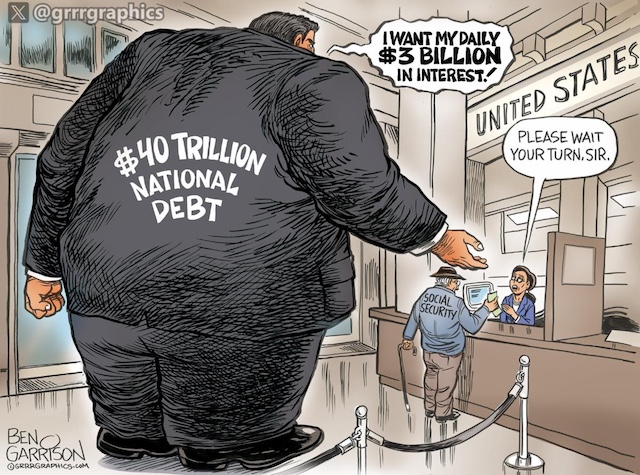 The U.S. national debt is projected to hit the $40 trillion milestone by the end of this month. The cost to service that debt will cost approximately $3.18 billion per day, according to Congressional Budget Office.
 Through the ongoing process of exchange, people eventually settled on gold as their preferred medium of exchange. Some commentators cast doubt that gold could fulfill the role of money in the modern world. It is held that, relative to the growing demand for money because of growing economies, the supply of gold is not growing fast enough. ~ According to
 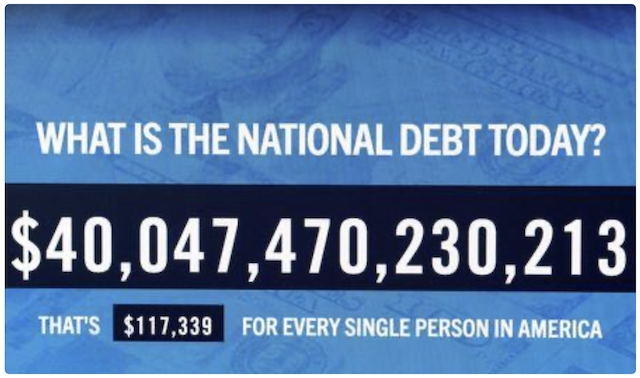 The Treasury’s latest daily cash and debt balances statement showed total public debt outstanding at $40.047 trillion on Tuesday, a total that includes Treasury securities held by the public of $32.266 trillion and intra-governmental debt holdings of $7.782 trillion.
 The dollar index (DXY00) tumbled to a 2.5-month low on Wednesday and finished down by -0.80%. The dollar retreated on Wednesday after the US Treasury boosted liquidity and announced plans to increase buybacks of long-dated bonds. Lower T-note yields on Wednesday also weakened the dollar‘s interest rate differentials.
 Bank failures are rare, but they have arrived at an unusually steady pace this year. Four federally insured banks have now closed and been placed under Federal Deposit Insurance Corporation receivership in 2026, already double the number recorded in all of 2025. For anyone who keeps a large balance parked in a single institution, each closure is a reminder that federal insurance protects deposits only up to a fixed ceiling.
 The price of gold hit its highest level since early June on Wednesday, breaking out of what has been a largely stagnant summer for the precious metal, with analysts crediting the price increase to the Treasury Department’s liquidity support announcement and a weakening dollar.
 Wells Fargo Revamps Gold Price Target for the Rest of 2026
 For the first 40 years after President Nixon closed the gold window in 1971, central banks mostly unloaded their gold to exercise their faith in fiat money. In 2011, however, Congress passed the Budget Control Act of 2011, which raised the debt ceiling by $2.4 trillion through 2012. As a direct result of that move, Standard & Poor’s downgraded Treasury credit debt from AAA to AA+, the first time since the 1980s U.S. debt was rated below the top (AAA) rating.
 Gold cracked $4,400 an ounce on August 11, and the VanEck Gold Miners ETF (NYSEARCA:GDX) has finally moved with it. GDX is up almost 18% over the last month and 53% over the last year, though still only around 3% year to date, a reminder of how long producers lagged bullion before the July breakout. At roughly $88, GDX is trading at levels the fund has not held in over a decade.
 Construction workers in Belgium stumbled upon a stash of gold believed to be worth more than $10 million during renovation work on a building.
 Gold traders have had a hard time getting this year right. The metal has swung from record highs to steep drops and back again. Most of the people who trade it are still trying to figure out which move to trust.
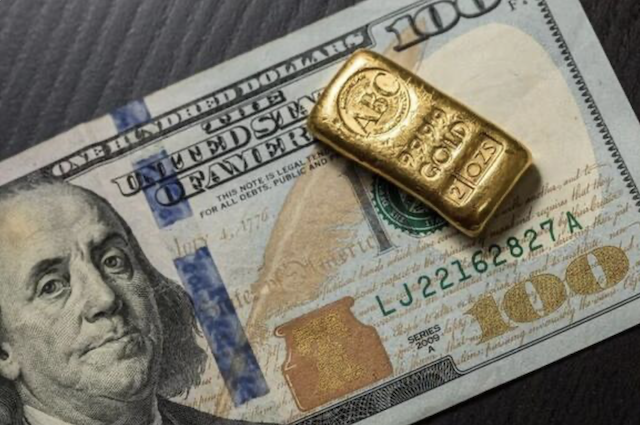 For years, the financial news space has been flooded with narratives of dollar doom, an incoming hyperinflation, and gold winning once the U.S. currency finally dies.
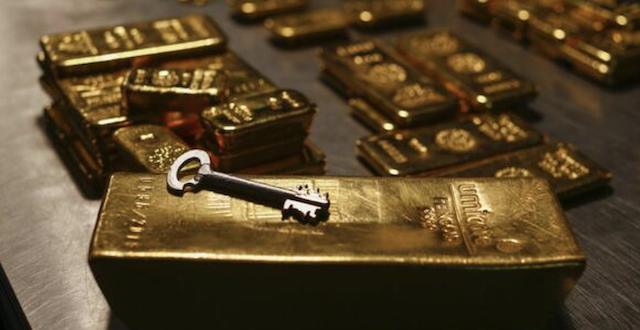 As of the European session on August 11, gold prices (XAUUSD) briefly topped $4,400 intraday, reaching a high of $4,435.2, its highest level since June 5. However, gains subsequently narrowed significantly as gold pulled back to around $4,360. Gold has been consistently strong recently, with the core driver being market expectations of further Federal Reserve rate hikes waning following a cooling U.S. labor market. Nevertheless, an intraday rise in crude oil prices reignited inflation concerns, causing gold to face noticeable profit-taking above $4,400.
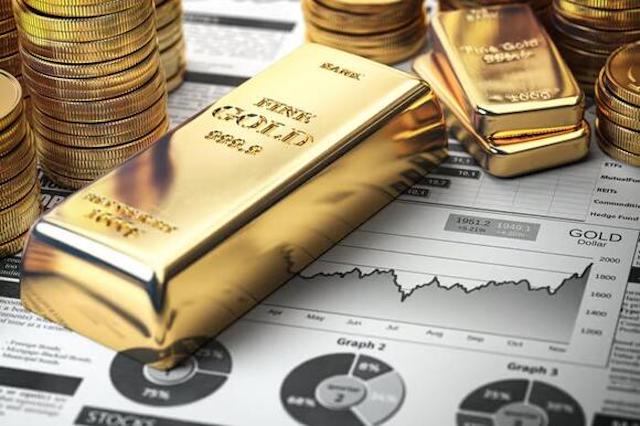 There should be a sign on the front of the Eccles Building in Washington saying, “We work for the elites – the commercial bankers and government – at the expense of everyone else. Try and stop us.”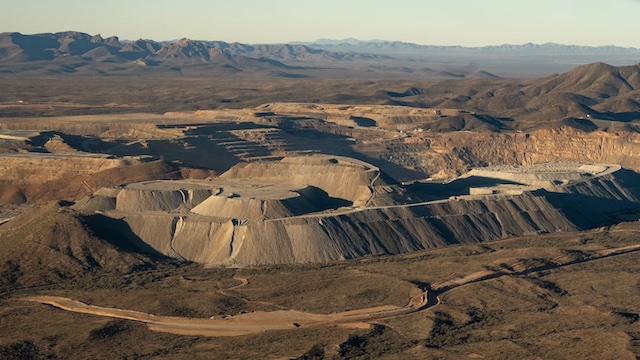

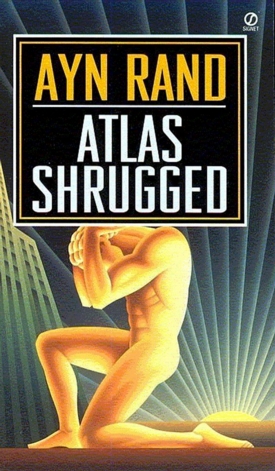 July 1, 2002 ~ Millions of people who have read Ayn Rand’s 1957 monumental work “Atlas Shrugged” must have been impressed by an insert that could be entitled “Hymn to Money”. This insert is buried in the 1600 pages of the novel and is difficult to find. However, it is a self-contained literary masterpiece in its own right. For these reasons it may be a good idea to publish it separately.