ART. XIII. -HISTORICAL SKETCH OF PAPER CURRENCY
Hon. C. Gayarre, pp. 77-87, 1866
INVENTION OF PAPER MONEY- FRENCH EXPERIENCE – JOHN LAW ENGLISH EXPERIMENTS – COLONIAL – RUSSIAN – CONFEDERATE STATES – OUR NATIONAL CURRENCY.
This article, which has been for sometime upon our table, has been amended in a few particulars by the author, and slightly enlarged. It is an interesting discussion of the paper money question from the pen of one of the leading literary and practical men of the South; the author of the “History of Louisiana,” and other valuable works. – Editor.
 In the latter months of the year 1863, only two years after the beginning of the great struggle which has lately terminated, and long before there was any doubt, in the Southern Confederacy, of its final success, its paper currency had depreciated to an extent which made it almost valueless. This was looked upon as the natural and inevitable consequence of its excessive redundancy, but that redundancy was not the only reason of its depreciation, because it would have depreciated without it, although to a much less degree. We believe it may be laid down as an almost settled axiom, without much fear of any successful refutation, that depreciation is of the very essence of paper money, whether it exceeds or not the wants of the community where it is current-that its over-issue only accelerates, or increases the depreciation-and that the depreciation becomes still more rapid and fatal when that paper, either by the action of Government, or from the no less powerful dictates of circumstances becomes a forced currency.
Before proceeding further, let us, on the threshold of this disquisition, determine what we are to understand, strictly speaking, by paper currency. We wish it therefore to be kept in mind that we mean by paper currency all notes or obligations which are intended as a substitute for coin, and which are not redeemable on presentation in metallic currency, to the full amount of the promise to pay contained in those notes or obligations. Otherwise-that is, when it can be converted at will into gold or silver, or is believed to be thus convertible-it does not circulate as paper currency, but merely as the convenient and useful representative of metallic currency, over which it possesses a decided advantage for transportation and for other purposes of trade; and so long as this is the case it does not depreciate. Continue reading →

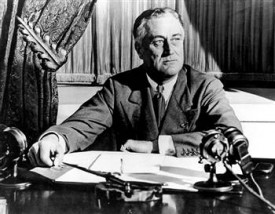 By virtue of the authority vested in me by Section 5(b) of the Act of October 6, 1917, as amended by Section 2 of the Act of March 9, 1933, entitled “An Act to Provide relief in the existing national emergency in banking, and for other purposes,” in which amendatory Act Congress declared that a serious emergency exists, I, Franklin D. Roosevelt, President of the United States of America, do declare that said national emergency still continues to exist and pursuant to said section do hereby
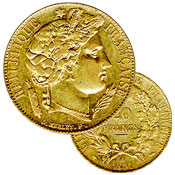 At the end of World War I, in the year 1918, Frenchman Jacque Dupré inherited the equivalent of $325,000.00 American dollars. Dupré used his inheritance wisely by converting it all into French, 20 franc gold coins. Each day for the rest of his life Monsieur Dupré spent the total sum of one gold coin to meet his needs – food, clothing, shelter, entertainment and medical.