For now, everything looks wonderful and coming-up-roses for a good many top-tier and upper-middle class folks. Just wait. The other shoe’s fixin’ to fall.
 The American economy today presents a glittering facade: stock indexes shattering records under the current administration, retirement accounts swelling for those who own them, and headlines proclaiming a new era of prosperity. Yet beneath this surface lies a structural fragility that no amount of official optimism can conceal.
For the average working family — whether a factory hand in Tennessee, a small-business owner scraping by, or a retiree stretching a fixed income — the warning signs are unmistakable. We are hurtling toward an economic collapse that will dwarf the 2008 financial crisis and rival, if not exceed, the misery of the Great Depression. The reasons are not mysterious or accidental. They flow directly from decades of government meddling, central-bank manipulation, and a refusal to let markets — real markets, governed by the discipline of profit and loss — do their job.
At the heart of the danger sits an unfunded federal liability bomb of roughly $169 trillion in off-the-books obligations, a figure that dwarfs official debt and represents promises future taxpayers cannot possibly keep. Add to that a wealth pyramid that has grown dangerously steep, a stock market now propped up as a matter of “national security,” and a culture that shields giant corporations from the consequences of their own folly.
The result is not sustainable prosperity but a house of cards built on borrowed money, printed dollars, and political favoritism. Americans of every background must prepare — not with panic, but with the clear-eyed realism that liberty demands.
To see the gathering storm, begin with the facts of wealth concentration in America since the mid-1970s. This is no statistical mirage cooked up by envious academics. Data from tax records and the Federal Reserve’s own Distributional Financial Accounts show that the inflation-adjusted net worth of the top 0.001 percent of households has exploded by about 3,500 percent. The top 0.01 percent gained roughly 2,200 percent, and the top 0.1 percent about 1,200 percent. Meanwhile, median household wealth rose only around 200 percent, and the bottom half of Americans spent nearly two decades with more debts than assets before a brief, stimulus-fueled bump after 2020.
Today roughly 430,000 households sit atop $30 million or more, and 74,000 command $100 million plus. The ultra-wealthy hold the bulk of their riches in corporate stocks, mutual funds, and private businesses — assets whose returns have compounded far faster than wages or home equity for everyone else. The bottom 50 percent still owns almost nothing in the productive capital that actually generates growth; their modest holdings are mostly houses (often carrying heavy mortgages) and everyday goods.
This divergence did not happen in a vacuum of pure free-market magic. It reflects what economist Thomas Piketty described as r > g: the private return on capital consistently outrunning the overall growth rate of the economy and wages. When capital compounds faster than the broader society produces new wealth, those who already own it pull steadily ahead. Higher savings rates among the affluent (they sock away about 35 percent of income while most families save almost nothing) feed still more investment, widening the gap.
But here the conservative must draw a crucial distinction. This is not the natural outcome of honest enterprise. Policy choices made it worse. Repeated rounds of easy money from the Federal Reserve — near-zero interest rates, massive bond-buying, and engineered asset inflation — pumped up stock and real-estate prices for those who already owned them. Tax policy tilted further in favor of capital gains and away from wage income. Globalization and technology rewarded the highly skilled and the owners of scalable businesses, while routine labor faced competition from abroad and automation. The result is a “K-shaped” economy: the top 10 percent of earners, who own over 90 percent of stocks, drive nearly all consumer spending and thus most GDP growth. The bottom 90 percent wrestle with rising costs for food, housing, and fuel. Consumer spending is 70 percent of the economy; when the asset-rich feel poorer, the whole machine stalls.
None of this is necessarily zero-sum. Total real wealth has grown dramatically because entrepreneurs and innovators created value — new technologies, medicines, conveniences — that lifted living standards across the board. The average American today enjoys comforts once reserved for kings. Yet the distribution has polarized around ownership of productive assets, and that polarization carries real dangers for every family. Intergenerational mobility — the great American promise that a child can out-earn and out-achieve his parents — has weakened. When wealth buys better schools, networks, and startup capital, children born into the bottom half inherit not just less money but lower odds of climbing.
Family formation itself frays: stable two-parent homes become rarer outside the top tier because economic insecurity raises the cost of marriage and children. Communities lose cohesion. Public budgets strain under transfer payments. And when the inevitable correction arrives, the median family — without buffers of stock portfolios or private equity — will absorb the worst of the blow.
That correction is coming, and it will be brutal because the foundation beneath the boom is hollow. Policymakers have turned the stock market into a national-security crutch. Roughly 58 percent of households have some exposure to stocks, and nearly half of all household wealth is tied to them. A serious bear market is therefore treated as an existential threat. When stocks dipped sharply in early 2025 amid trade tensions, erasing trillions in paper wealth, major companies immediately reported recessionary drops in spending.

The Federal Reserve Bank in Flames
The Federal Reserve and political leaders responded the only way they know how: verbal jawboning, fresh liquidity, and implicit guarantees that asset prices must not be allowed to fall too far. The dirty secret is that central banks cannot create real growth or jobs; they can only cheapen credit and inflate asset bubbles to make people feel richer so they keep spending. Since 2008 the dollar has lost roughly a third of its purchasing power. That devaluation has driven capital into stocks, real estate, and even gold. Gold is now breaking out relative to the S&P 500, signaling higher inflation ahead. The bull market is real in nominal terms, but it is also artificial — sustained by the very monetary distortion that makes the eventual bust more severe.
Layer on top of this the $169 trillion in unfunded liabilities — Social Security, Medicare, federal pensions, and other long-term promises that sit off the official books. These are not theoretical; they are legal obligations that grow inexorably with demographics and medical costs. Official debt is frightening enough, but this hidden mountain represents a future tax burden or inflation tax that cannot be wished away. When the bills come due, Washington will face three ugly choices: slash benefits (politically impossible), raise taxes dramatically (choking growth and driving capital overseas), or print money on a scale that makes past quantitative easing look quaint.
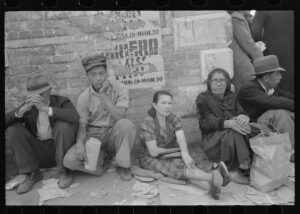 Any of those paths risks triggering the very collapse we have tried to avoid. The 2008 crisis was painful because a housing bubble popped and banks over-leveraged. What is coming is larger: a sovereign debt and entitlement crisis colliding with a stock-and-real-estate bubble propped up by fiat money. The Great Depression saw unemployment above 20 percent and widespread bank failures. A modern version would feature not only job losses but collapsing retirement accounts, underwater mortgages, spiking food and energy prices, and a currency that loses value faster than wages can catch up. Families who live paycheck to paycheck will face choices between groceries and rent. Small businesses without access to cheap credit will fold. The social fabric — already strained by fragile families and eroding trust— could tear further.
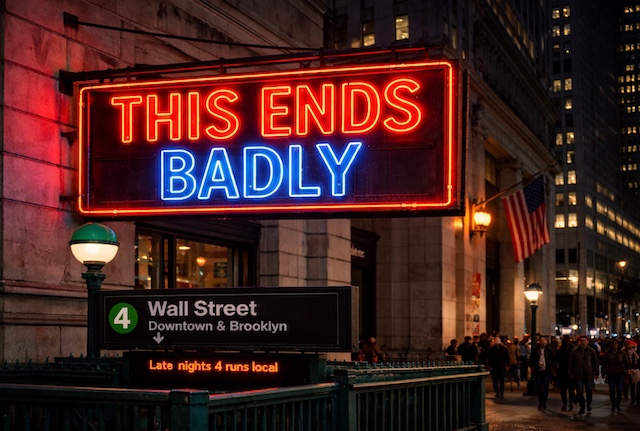
It could not be any clearer than if it was a fucking neon sign flashing THIS ENDS BADLY hanging outside of the #4 train station on Wall Street so industry workers are forced to look at it every morning on their way to work.
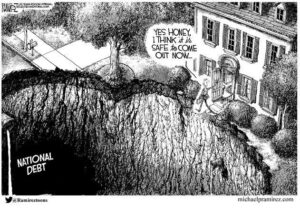
Our American mountain of national debt currently sits at $40 trillion and the economy is headed toward one enormous, gigantic collapse, unless President Trump’s gambit with Artificial Intelligence and oil captures in Venezuela and Iran have a significant payout sooner rather than later, and if his administration can continue to achieve real successes in conjunction with the measures currently implemented to successfully manipulate the market and keep the economy moving along and “growing”, in a manner that keeps the U.S. economy stable. The printing presses are operating at hyper-speed to fill the coffers of Wall Street and Trump’s billionaire crony brethren, and as much as President Trump always talks a great game on how much he loves America and the American people, aside from a few good gains in the energy industry and regarding the taxation of Americans, it’s virtually impossible for any man with good powers of reasoning during these tumultuous times, to see the American people as anything other than pawns of the Crony-Capitalists still, who preceded President Trump and now support him – those same-powers-that-be who have slowly destroyed our standard of living, by and large, over the last fifty years as the end game draws near.
Years ago, Frank Zappa predicted:
 “The illusion of freedom will continue as long as it’s profitable to continue the illusion. At the point where the illusion becomes too expensive to maintain, they will just take down the scenery, they will pull back the curtains, they will move the tables and chairs out of the way and you will see the brick wall at the back of the theater.”
At this point the liberty-minded American must confront the moral and practical rot of “Too Big to Fail.” In 2008 we were told certain banks and corporations were so vital that taxpayers had to rescue them from their own reckless bets. That was a lie.
No private enterprise is so important that it must not be allowed to fail. Bankruptcy exists precisely for this reason: it forces managers and investors to face reality, wipes out bad debt, reallocates capital to better uses, and sends a clear signal that future adventurism carries risk. Bailouts do the opposite. They privatize gains and socialize losses. They reward the politically connected while punishing the prudent saver or small competitor who played by the rules. They entrench moral hazard — knowing the government will ride to the rescue encourages even larger gambles next time. Crony-Capitalism is not free enterprise; it is corporate welfare dressed up as stability. It concentrates power in Washington and Wall Street, erodes the rule of law, and widens the very wealth gap we lament.

Crony-Capitalism
True conservatism rejects Crony-Capitalism on principle. The market is not cruel; it is honest. Letting failed firms go through Chapter 11 or liquidation is how resources move from incompetent hands to productive ones. Shielding them only guarantees that the next crisis will be bigger, because the bad actors never learn.
The path ahead is therefore not hopeless, but it demands personal responsibility and a return to first principles.
Americans cannot count on Washington to fix what it broke. Families should build real buffers: reduce debt, diversify beyond paper assets, acquire skills that cannot be outsourced or automated, and strengthen the human capital that no central bank can print — strong marriages, involved parenting, local community ties. Hard assets like firearms and ammunition, medicines and food with long shelf lives, personal water filtration systems, good used automobiles, 55-gallon drums of gasoline, gold, productive land, or ownership stakes in sound businesses have historically preserved value when currencies falter.
Most important, citizens must insist that policy change. End the endless bailouts. Restore sound money and fiscal sanity. Simplify taxes so they do not favor capital over labor or insiders over outsiders. Broaden capital ownership not through redistribution but through genuine opportunity — school choice, deregulation that unleashes small business, and incentives for saving and investment that reach every rung of the ladder. Above all, reject the siren song of more government “protection.” The same force that promises to cushion every fall is the force that created the bubble in the first place.
The American experiment has always rested on the belief that effort and character, not birth or political favor, should determine outcomes. That belief is under siege not by markets but by the very interventions sold in their name. The coming reckoning will test whether we still possess the courage to face reality, let markets clear, and rebuild on firmer ground. Preparation is not pessimism; it is the practical expression of faith in individual liberty and self-reliance.
The storm is gathering. The time to secure your own house — and to demand that the nation’s house be put in order — is NOW.
April 25, 2026

Justin O. Smith ~ Author
~ the Author ~
Justin O. Smith Has Lived in Tennessee Off and on Most of His Adult Life, and Graduated From Middle Tennessee State University in 1980, With a B.S. And a Double Major in International Relations and Cultural Geography – Minors in Military Science and English, for What Its Worth. His Real Education Started From That Point on. Smith Is a Frequent Contributor to the Family of Kettle Moraine Publications.