Americans don’t need a press release to know that inflation is rising. Gasoline is above $4 per gallon amid the ongoing conflict in the Middle East and closure of the Strait of Hormuz, and the release of key price data on May 28, 2026, underscores why policymakers are worried these pressures could spread into the broader economy.
The report offered a mixed but still uncomfortable picture. The month-to-month rise was softer than expected, but the change year over year still points to concern: a 3.8% jump from a year earlier, the fastest pace since 2021, and a less volatile index that excludes food and energy up 3.3%. Continue reading →
Posted inThe Mine or the Shaft|Comments Off on It’s Not Just High Gas Prices – Inflation Is Now Spreading Through the US Economy
Fuelled by frenetic speculation, and by the idea that everyone can get rich without limits, it puts a final stop to the euphoria of the 1920s.
America is then caught in a devastating cycle which spreads around the world a few months later like a malign infection.
More Than Half of Americans Say the Cost of Living Is Worse Under Trump Than at Any Other Point in Their Lives A majority of Americans now say the cost of living is the worst they can remember — and most of them blame President Donald Trump for their predicament.
Poll results published Friday by Politico showed 53 percent of those surveyed couldn’t recall struggling harder to make ends meet, up from 46 percent in November.
The poll by Public First also found 46 percent felt Trump was fully or mostly responsible for the state of the economy, unchanged from six months ago…. (Continue to full article)
U.S. Tractor Sales Fall 21.6%, Combine Sales Drop 56% From 2025 Sales data shows that U.S. tractor sales were down 21.6% and combine sales decreased 56.1% year-over-year in May 2026, according to the Association of Equipment Manufacturers (AEM).
Canadian sales of combines were 80, down 56.5% from 184 in May 2025. Canadian tractor sales were 1,976 for May, down 17% from May 2025.
Sales for self-propelled combines in the U.S. were down 56.1% in May, with 138 sold this year compared with 314 last year. Year to date, AEM reports 1,066 combines have been sold as of May, down 14.6% from 1,248 at the same time last year. Self-propelled combine inventory began at 714 in May… (Continue to full article)
Is Washington State Coming After Farmers and Ranchers – Are Regulators Trading Away Food Production To Secure “Environmental Justice“? The King family in eastern Washington has raised cattle on its property since the 1950s. In addition to ranch property it owns, the King family has also leased from the state nearly 13,000 acres of grazing land for its cattle since the 1950s.
During dry months the King Ranch maintains watering holes for the cattle and wildlife. Many of these watering holes go back to before the King family owned or leased the land, and the activity in connection with them has only been done for the purpose of maintenance.
Based on an anonymous complaint, and an investigation using Google Earth satellite imagery, the Washington Department of Ecology (WADOE) accused the King Ranch of illegally excavating “wetlands” — a wet spot in arid areas in violation of state law. The WADOE imposed a penalty in excess of $250,000, and ordered the King family to implement a 10-year restoration plan estimated to cost them over $3.5 million to fully comply with.
Maybe they can grow carrots and squash on roof-top gardens in economically disadvantaged neighborhoods that Bill Gates can use to make fake meat…. (Continue to full article)
No country other than the US could cope with a currency burdened by a $500 billion deficit and skyrocketing international debt. Instead of rising up and plunging the country into chaos, the American public goes about its daily business, and calm is maintained in the boardrooms.
Whether it soars or plummets – somehow the dollar’s antics always seem to have a negative impact on others. This exorbitant privilege of passing on its debts to others stems from the fact that, since the post-war period, the dollar has developed into the international currency. It is hardly ever questioned. The dollar is thus the ultimate symbol of the US’s economic strength, imperialism and supremacy. The only question is: will it stay that way? Or are we currently at the end of an era?
Posted inThe Mine or the Shaft|Comments Off on The Dollar Dominance: How America Gets Away with Endless Debt
Did you know that the purchasing power of the U.S. dollar has fallen by more than 97 percent since 1913? Sadly, as you will see below, the decline in the purchasing power of our currency appears to have greatly accelerated in recent years. Thanks to the rising cost of living, most Americans have lost faith in the American Dream. In fact, a new survey that was just released discovered that 51 percent of us believe that the American Dream is now out of reach for most people… Continue reading →
Posted inThe Mine or the Shaft|Comments Off on Snyder: The Purchasing Power Of The Dollar Has Collapsed And The Majority Of The Population No Longer Believes In The American Dream
There is a high likelihood that, due to the past large decline in the yearly growth rate of the money supply, the US economy is heading towards an economic bust. Continue reading →
In the shadowed annals of human striving, where fortune’s wheel turns with inexorable force, few spectacles provoke deeper unease than the concentration of unimaginable riches in a single pair of hands. A trillion dollars – more wealth than many nations command, a sum vast enough to dwarf the economies of continents – rests now, for the first time in history, within the grasp of one man. Elon Musk, that restless engineer of rockets and circuits, stands as the emblem of this milestone. Yet the achievement, while born of ingenuity and daring, stirs ancient moral qualms.
With plainspoken candor, I ask, just what does any one single person do with so much incredible wealth in his sole possession?” Continue reading →
Posted inViewpoint|Comments Off on Smith: Stewardship, Virtue, and the Trillionaire Question… The Moral Weight of Wealth!
“The barbarian hopes — and that is the mark of him, that he can have his cake and eat it too. He will consume what civilization has slowly produced after generations of selection and effort, but he will not be at pains to replace such goods, nor indeed has he a comprehension of the virtue that has brought them into being. We sit by and watch the barbarian. We tolerate him in the long stretches of peace, we are not afraid. We are tickled by his irreverence; his comic inversion of our old certitudes; we laugh. But as we laugh we are watched by large and awful faces from beyond, and on these faces there are no smiles.” ~ Hilaire Belloc,This and That and the Other, 1912
There is perhaps no greater misunderstanding in modern American life than the widespread belief that the economic system under which we presently live bears a close resemblance to the free-market capitalism envisioned by the architects of classical liberalism. Across the political spectrum, citizens increasingly express dissatisfaction with economic outcomes they attribute to capitalism itself. Continue reading →
Posted inThe History of it All|Comments Off on Smith: America’s Drift From Free Markets to Economic Fascism
There is a particular kind of financial wisdom that used to be passed down at kitchen tables. A grandparent, someone who remembered harder times, would explain that the first obligation of a responsible person was to spend less than they earned, put something away, and let patience do its quiet work. The savings account was not a sophisticated instrument. It was a vessel for deferred consumption – a way of translating present discipline into future security. The interest it paid was modest, but it moved in the same direction over time.
That world has not merely changed. It has been, in a precise and largely unacknowledged sense, inverted. Continue reading →
Posted inThe Mine or the Shaft|Comments Off on There Is No Reprieve in the Fed’s War on Savings
Social Security recipients are usually already working on a shoestring budget. However, policy shifts from the Trump administration mean those monthly funds could shrink due to a pair of new(ish) benefit offsets – one that is already taking a bite out of checks, and another looming on the horizon.
That means people could be looking at smaller monthly payments. Keep reading to find out what is being proposed and whether or not it could impact your Social Security payments. Continue reading →
Posted inThe Mine or the Shaft|Comments Off on The Trump Administration Is Already Taking a Bite Out of Your Social Security Payments – and They May Be Going in for a Second
~ Quotables ~ "There is no clean way to make a hundred million bucks. Somewhere along the line guys got pushed to the wall, nice little businesses got the ground cut out from under them. Decent people lost their jobs. Big money is big power, and big power gets used wrong. It's the system." ~ Raymond Chandler, The Long Goodbye
We make every attempt to respect the rights of others. If you feel that something here has infringed your work please let us know and we will correct it immediately. It is not always easy to determine the status of material posted to the Internet with regard to fair use and public domain.
~ FAIR USE NOTICE ~
This site contains copyrighted material the use of which has not always been specifically authorized by the copyright owner. We are making such material available in our efforts to advance understanding of environmental, political, human rights, economic, democracy, scientific, and social justice issues, etc. We believe this constitutes a ‘fair use’ of any such copyrighted material as provided for in section 107 of the US Copyright Law. In accordance with Title 17 U. S. C. Section 107, the material on this site is distributed without profit to those who have expressed a prior interest in receiving the included information for research and educational purposes. For more information go to: http://www.law.cornell.edu/uscode/17/107.shtml

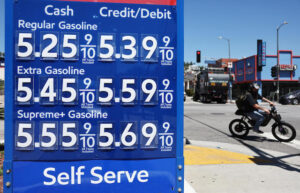 Americans don’t need a press release to know that inflation is rising. Gasoline is above $4 per gallon amid the ongoing conflict in the Middle East and closure of the Strait of Hormuz, and the release of key price data on May 28, 2026, underscores why policymakers are worried these pressures could spread into the broader economy.
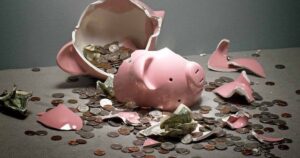 A majority of Americans now say the cost of living is the worst they can remember — and most of them blame President Donald Trump for their predicament.
 Sales data shows that U.S. tractor sales were down 21.6% and combine sales decreased 56.1% year-over-year in May 2026, according to the Association of Equipment Manufacturers (AEM).
 The King family in eastern Washington has raised cattle on its property since the 1950s. In addition to ranch property it owns, the King family has also leased from the state nearly 13,000 acres of grazing land for its cattle since the 1950s.
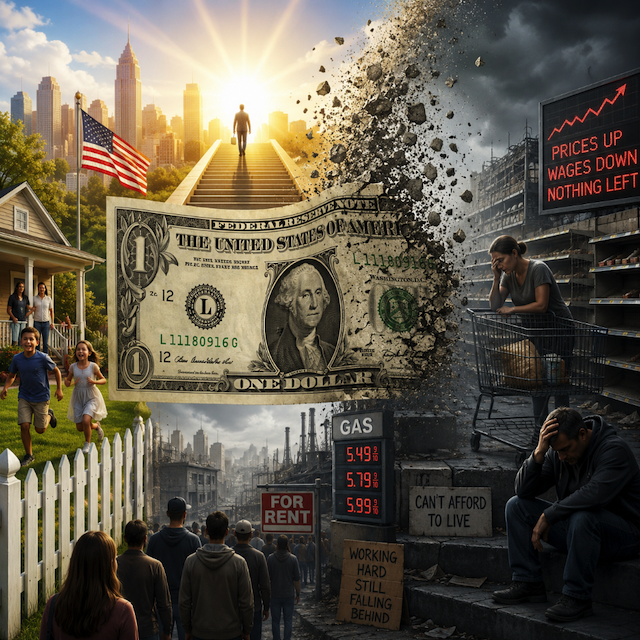 Did you know that the purchasing power of the U.S. dollar has fallen by more than 97 percent since 1913? Sadly, as you will see below, the decline in the purchasing power of our currency appears to have greatly accelerated in recent years. Thanks to the rising cost of living, most Americans have lost faith in the American Dream. In fact, a new survey that was just released discovered that 51 percent of us believe that the American Dream is now out of reach for most people…
 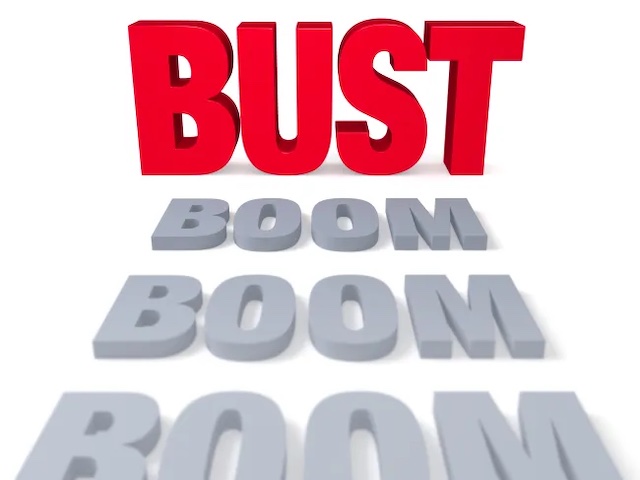 There is a high likelihood that, due to the past large decline in the yearly growth rate of the money supply, the US economy is heading towards an economic bust.
 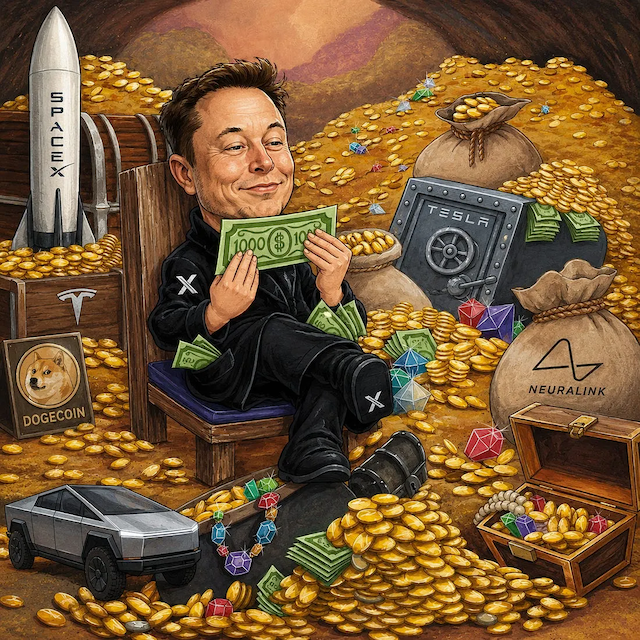 In the shadowed annals of human striving, where fortune’s wheel turns with inexorable force, few spectacles provoke deeper unease than the concentration of unimaginable riches in a single pair of hands. A trillion dollars – more wealth than many nations command, a sum vast enough to dwarf the economies of continents – rests now, for the first time in history, within the grasp of one man. Elon Musk, that restless engineer of rockets and circuits, stands as the emblem of this milestone. Yet the achievement, while born of ingenuity and daring, stirs ancient moral qualms.
 “The barbarian hopes — and that is the mark of him, that he can have his cake and eat it too. He will consume what civilization has slowly produced after generations of selection and effort, but he will not be at pains to replace such goods, nor indeed has he a comprehension of the virtue that has brought them into being. We sit by and watch the barbarian. We tolerate him in the long stretches of peace, we are not afraid. We are tickled by his irreverence; his comic inversion of our old certitudes; we laugh. But as we laugh we are watched by large and awful faces from beyond, and on these faces there are no smiles.”
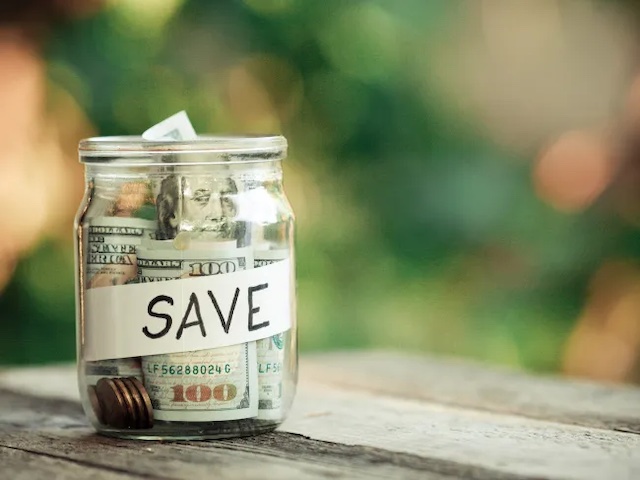 There is a particular kind of financial wisdom that used to be passed down at kitchen tables. A grandparent, someone who remembered harder times, would explain that the first obligation of a responsible person was to spend less than they earned, put something away, and let patience do its quiet work. The savings account was not a sophisticated instrument. It was a vessel for deferred consumption – a way of translating present discipline into future security. The interest it paid was modest, but it moved in the same direction over time.
 Social Security recipients are usually already working on a shoestring budget. However, policy shifts from the Trump administration mean those monthly funds could shrink due to a pair of new(ish) benefit offsets – one that is already taking a bite out of checks, and another looming on the horizon.